

Legal Regulations of Digital Platforms: Search Engine Market Monopoly and the Act on Promotion of Competition for Specified Smartphone Software
Chuo University and Otemachi Academia No. 12
Mika Nakashima/Professor, Faculty of Global Informatics, Chuo University

The twelfth webinar in the Otemachi Academia collaborative course, organized jointly by Chuo University and the Yomiuri Newspaper to give back the university's invaluable knowledge to society, took place on February 12. The theme was "Legal Regulations of Digital Platforms: Search Engine Market Monopoly and the Act on Promotion of Competition for Specified Smartphone Software (hereinafter, the 'Mobile Software Competition Act')." Professor Mika Nakashima of Chuo University's Faculty of Global Informatics delivered an online lecture on the current state of digital platforms and the significance of the Mobile Software Competition Act. During the subsequent discussion, she examined the topic more deeply through dialogue with Yasuaki Kobayashi, a reporter from the Economics Bureau in the Editing Department of Yomiuri Shimbun Tokyo Headquarters.
The state of smartphones today
Professor Nakashima began by explaining digital platforms. These platforms often refer to services provided by companies commonly known as "GAFA," an acronym for Google, Amazon, Facebook (now Meta), and Apple. Digital platforms share two notable characteristics: the two-sided market and the indirect network effect.
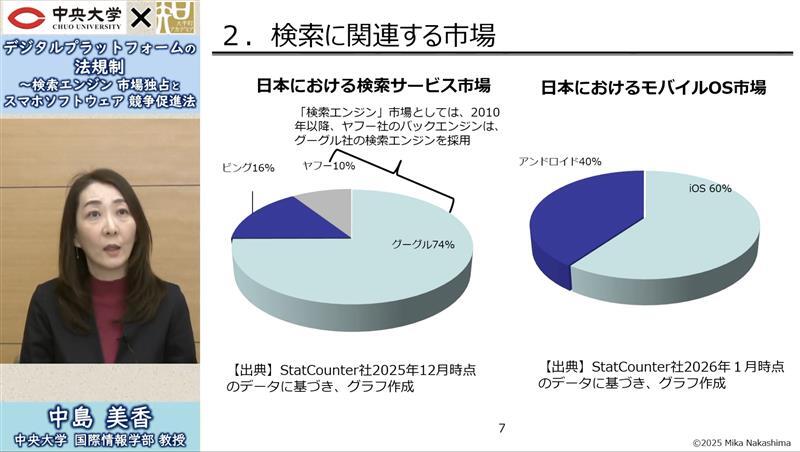
The two-sided market in search services is a business model in which the service is offered to users free of charge while generating revenue from search-linked advertising paid by advertisers. In this model, the more users engage with the service, the more data is collected. The indirect network effect occurs when increased advertising revenue improves search accuracy and service quality, thereby creating a virtuous cycle that attracts even more users and advertisers.
While noting that such business models are highly innovative, Professor Nakashima explained that they pose challenges from a legal perspective. Notably, it is difficult to define markets and identify violations. As a result, traditional antitrust law has been insufficient, creating the need for new legislation. This led to the enactment of the Mobile Software Competition Act.
Professor Nakashima also discussed how the Mobile Software Competition Act features ex-ante regulation, which anticipates potential concerns from platforms in advance and imposes preventive obligations.
Professor Nakashima highlighted that Google currently holds a high market share in Japan's search service market. She also cited a concrete example of Mobile Software Competition Act's effect; specifically, with its enforcement, the Safari browser on iPhones now presents alternative search engine options clearly.
At this point in her lecture, Professor Nakashima emphasized the importance of competition. A de facto monopoly by a single company like Google can be convenient and comfortable for users, who can complete tasks using a single service. It can also seem advantageous for device manufacturers, who receive a share of advertising revenue when Google search is installed on their devices. However, market monopolies create a risk of rising prices and declining quality of products and services. Professor Nakashima stressed that while the value of competition is invisible and not easily felt, it is something that we must actively protect using all available measures.
Business model of search engines
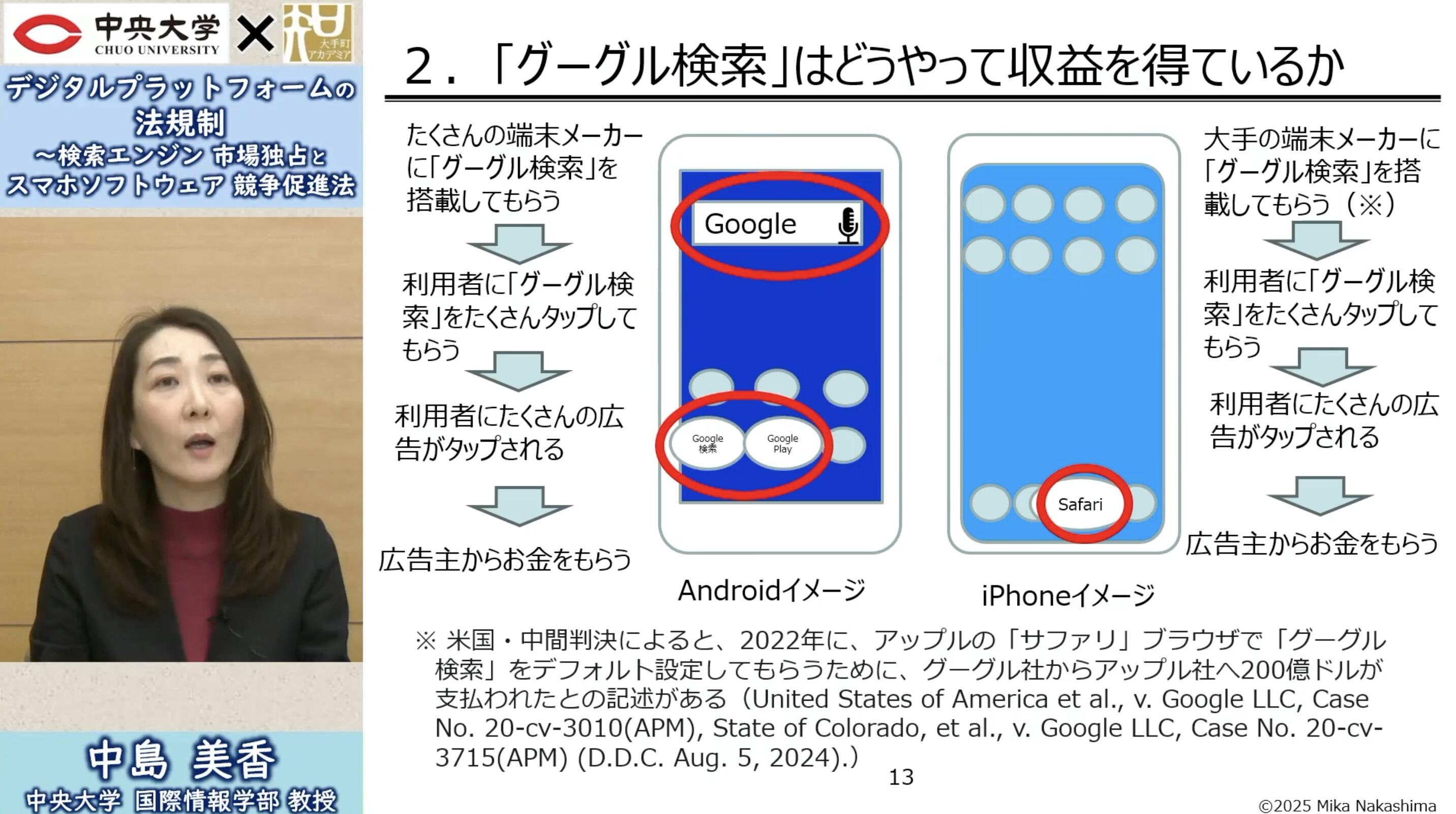
Next, Professor Nakashima discussed the business model of search engines in detail. The current smartphone OS market is a duopoly dominated by Apple and Google. Google provides the Android OS to device manufacturers free of charge and earns revenue from advertisers by having its search service used on as many devices as possible. Additionally, Google has contracts requiring the pre-installation of Google Search alongside its app store Google Play with device manufacturers.
Professor Nakashima highlighted how the constant visibility of Google Search creates a status quo bias in which users continue to use Google Search without giving it much thought.
She also cited court documents showing that, in 2022, Google paid Apple USD 20 billion (approximately JPY 3 trillion) globally to have Google adopted as the default search engine on Safari. This created a situation in which Google Search is overwhelmingly used.
Administrative orders, judicial decisions, and ex-ante regulation
Professor Nakashima compared administrative orders, judicial decisions, and ex-ante regulation across Japan, the U.S., and the EU. Regarding administrative orders and judicial decisions, she noted that the U.S. approach differs from other jurisdictions in that it does not limit its scope to specific OSs or devices. The U.S. also includes the issue of Google being adopted as the default search engine on Safari. In contrast, the EU and Japan focus only on Android search services. She further noted that although litigation is still pending in the EU and the United States, authorities in each jurisdiction have found Google's conduct to be unlawful.
Professor Nakashima noted the large number of iPhone users in Japan, that Google is set as the default search engine on Safari, and the possibility of substantial revenue sharing from Google to Apple. Based on these circumstances, she pointed out the necessity of considering the potential unlawfulness of transactions between the two companies in Japan as well.
Next, Professor Nakashima compared the measures addressing search engine monopolies under ex-ante regulation in the EU and Japan. As laws implementing ex-ante regulation, the EU has the DMA, and Japan has the Mobile Software Competition Act, whereas the U.S. has no equivalent. Regarding the provisions of these laws, both Japan and the EU require making it easier to change default settings and providing alternative search engine options. On the other hand, sharing data related to searches is required in the EU but is not currently mandated in Japan.
Consequences of unchecked monopolies
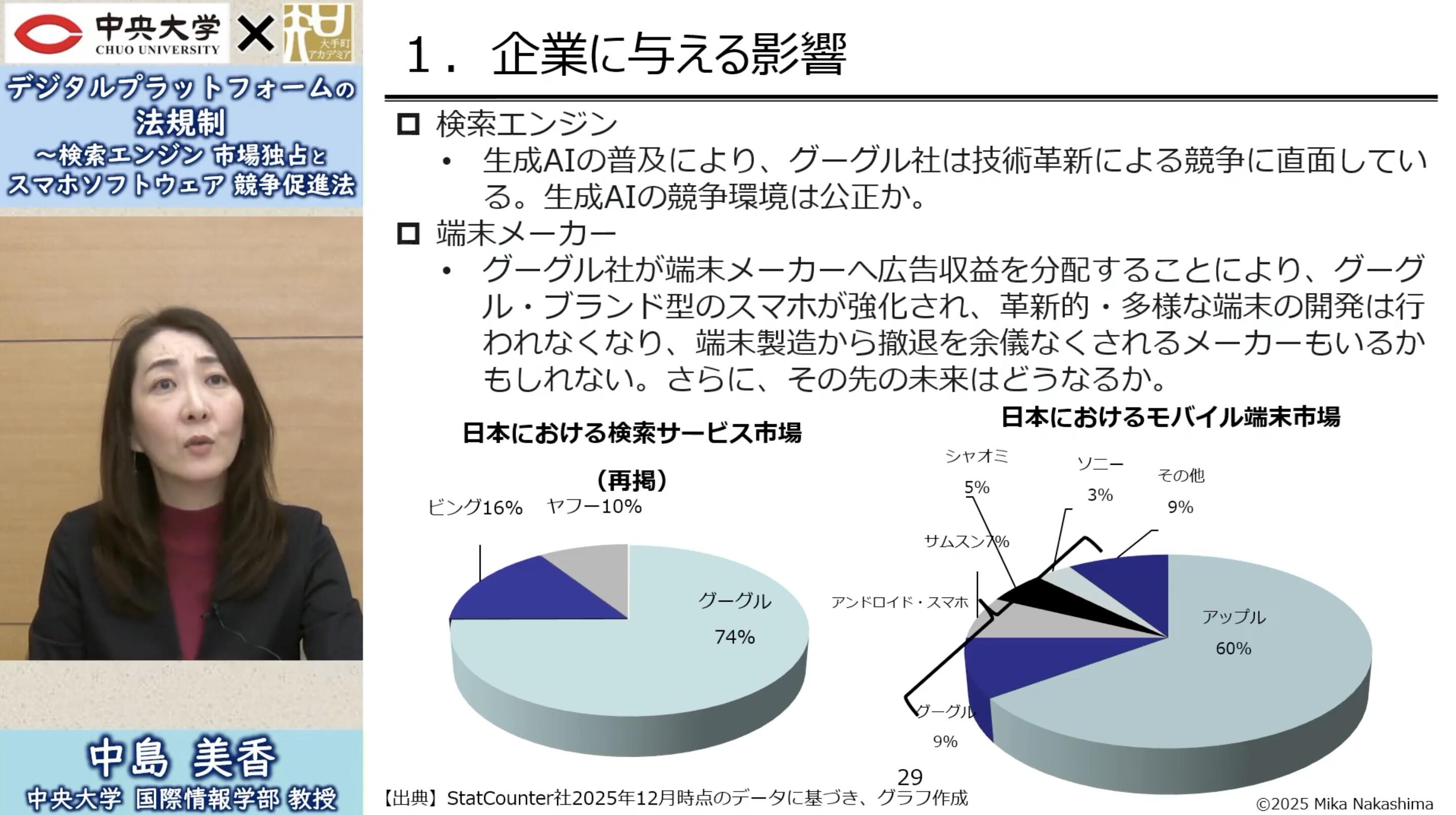
Professor Nakashima discussed how leaving a monopoly unchecked affects companies and users. She noted that in a situation where Google has a near monopoly on search engines, competition in developing technologies such as generative AI may not occur in a fair environment. For device manufacturers, this could mean that innovative and diverse devices may not be developed. Some manufacturers could even be forced to exit device production altogether.
When discussing the impact on users, Professor Nakashima raised the issue of freedom of choice in information. She emphasized that many people assume that large companies are trustworthy, and noted that corporate efforts have produced innovation and established brand value. However, in a situation without competitors and the accompanying competitive pressure, there is no guarantee that the quality of products or services will be maintained. Moreover, she warned that even if the CEO of a massive global company (with financial resources exceeding the budget of small nations) suddenly changed, the public cannot elect that CEO.
Professor Nakashima concluded her lecture by stressing how the role of antitrust law and the Mobile Software Competition Act has grown significantly. This increased role is due to how major digital platform companies now effectively control information flow and access to transactions across national borders. As her final point, she stressed that the ex-ante regulatory system must be properly implemented to fully realize its effects in promoting competition.
Discussion
The discussion with Yasuaki Kobayashi focused more specifically on the current situation and issues surrounding Google, which is known to dominate search engine services.
In response to concerns over its monopoly, Google argues that users voluntarily choose its search engine due to the high quality of its search results. Google also asserts that it is easy to switch to the search engines of competitors. Professor Nakashima countered that Google Search is pre-installed and set as the default, thus creating an environment where users are automatically led to Google Search when using their smartphones. "If Google were truly being chosen by users, Google wouldn't need to pay device manufacturers to eliminate its competitors," she astutely noted.
Regarding competition in the generative AI field, she noted that Google itself faces new competition driven by technological innovation. While this is a welcome development, she emphasized that without a fair competitive environment, these innovations may not reach their full potential. Once again, she underscored the importance of proper law enforcement.
* Click here for the video of the twelfth collaborative course with Otemachi Academia on February 12, 2026, titled "Legal Regulations of Digital Platforms: Search Engine Market Monopoly and the Act on Promotion of Competition for Specified Smartphone Software."
Mika Nakashima/Professor, Faculty of Global Informatics, Chuo University
Areas of Specialization: Civil Law and Information Law (Competition Policy)Mika Nakashima holds an LL.M from Tokai University.She completed the Doctoral Program without obtaining a degree in the Graduate School of Law, Tokai University in 2007.After serving as a Senior Researcher at the Regulatory Research Division of InfoCom Research, Inc., she was appointed as Associate Professor in the Faculty of Global Informatics, Chuo University in 2019 and Professor in 2025.
Her main academic papers include The U.S. Google Antitrust Case: August 2024 Ruling and the Significance of Digital Platform Regulations, SOFTIC Law Review, No. 3 (2025), Two Decisions by the Supreme Court Concerning Claims Against Google LLC. and Against Twitter Inc. to Delete Personal Data Published on Their Services: Formulas to Decide Claims, Japanese Journal of Global Informatics, No. 5 (2025), and more.

- Share articles


