

The World of Mathematics All Around Us: The Fascination of Numbers and Their Applications in Society
Lecturer: Kiwamu Watanabe/Professor, School of Science and Engineering, Chuo University
Areas of Specialization: Algebraic Geometry
Interviewer: Makoto Mitsui/Senior Research Fellow, Research Division, The Yomiuri Shimbun Tokyo Head Office
"Chuo University × Otemachi Academia" is a program that shares with the wider community the valuable knowledge Chuo University has cultivated throughout its history. The 13th session, titled "The World of Mathematics All Around Us: The Fascination of Numbers and Their Applications in Society," was held on May 27. Kiwamu Watanabe, Professor in Chuo University's Faculty of Fundamental Science and Engineering, explained in accessible terms the mathematics hidden in our everyday lives and the role mathematics plays in supporting modern society. In the discussion session following the lecture, he also spoke with Makoto Mitsui, Senior Research Fellow at the Research Division of The Yomiuri Shimbun Tokyo Head Office, about ways to overcome a sense of difficulty with mathematics and the impact of AI technology on mathematical research.
Mathematics in Everyday Life
At the beginning of the lecture, Professor Watanabe introduced his general-audience book 『数字がわかれば世界がわかる!すごすぎる数の図鑑』(KADOKAWA). Although the book deals with advanced topics, it is written so that readers who have not studied mathematics professionally, as well as children, can enjoy it. It covers a wide range of themes, including the mysteries of numbers, unsolved problems, and the relationship between mathematics and modern society. Drawing on the contents of the book, Professor Watanabe used concrete examples to explain how mathematics is connected to our lives and society.
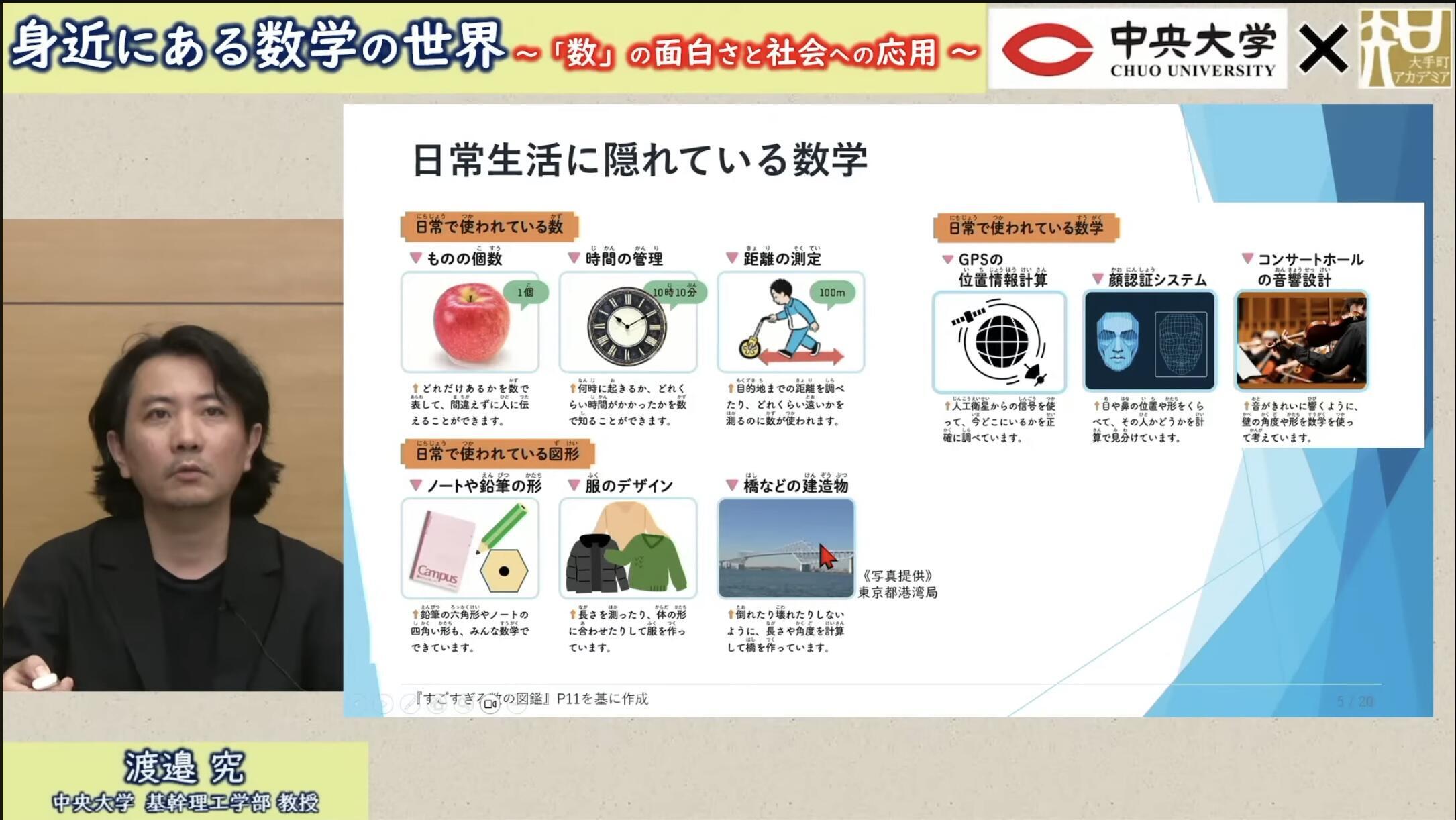
Professor Watanabe first explained that mathematics and the concept of numbers are present in countless aspects of daily life. Counting objects and checking the time are familiar examples, but numbers and shapes are used in all kinds of everyday situations. Mathematics is also used in technologies that may not at first seem connected to mathematics, such as GPS-based positioning calculations, facial recognition on smartphones, and acoustic design for concert halls.
"Mathematics is, in the first place, the language used to describe the natural sciences," Professor Watanabe said. When we try to analyze or examine phenomena scientifically, we inevitably use numbers and mathematics; in that sense, mathematics is used everywhere.
The Gap Between Human Intuition and Actual Numbers
Professor Watanabe then introduced several examples in which human intuition about numbers differs greatly from reality.
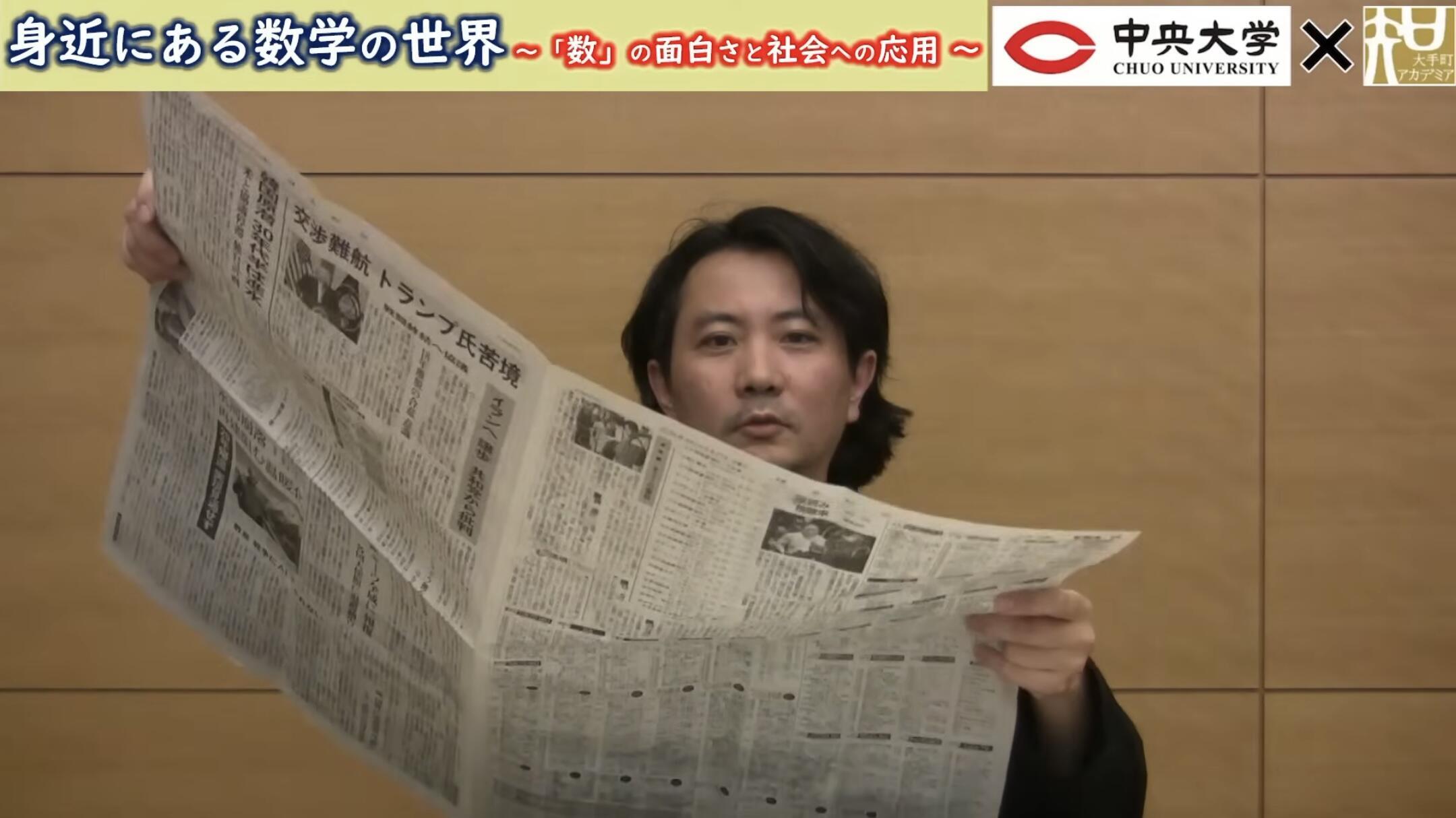
The first example concerned the thickness of a sheet of paper when folded. If a sheet of paper 0.1 millimeters thick is folded in half, its thickness doubles each time. After one fold it is only 0.2 millimeters thick, but after 20 folds it reaches about 105 meters, comparable to the height of a building. After 25 folds, it reaches about 3,355 meters, around the eighth station of Mount Fuji. In theory, after 42 folds, it would reach about 440,000 kilometers, a distance comparable to that between Earth and the Moon. A phenomenon that appears to grow only slightly at first but then increases rapidly after a certain point is called "exponential growth" in mathematics.
The second example concerned probability. Professor Watanabe discussed the odds of winning Japan's Year-End Jumbo Lottery, noting that the probability of winning the top prize is about one in 20 million. Considering that Tokyo has a population of about 14 million, he pointed out that the probability is so low that even if every Tokyo resident bought one ticket, it would not necessarily produce a winner among them.
He also referred to the odds of drawing a desired item in smartphone game "gacha," or random-draw systems. For example, when aiming for a rare character with a 1 percent draw rate, many people tend to think that drawing 100 times should produce one win. In reality, however, because the 1 percent probability applies independently to each draw, the probability of winning at least once in 100 draws is only about 63 percent.
Another idea he introduced was "six degrees of separation." This is the hypothesis that anyone in the world can be connected through a chain of six acquaintances. Suppose one person has 50 acquaintances, and each of those 50 people can introduce another 50 acquaintances. Then the network of human connections grows by powers of 50. By the sixth step, it reaches about 15.6 billion people, roughly twice the world's population. In reality, there would of course be overlaps, but a simple calculation shows that the scale would exceed the world's population within six steps. This, too, is one example of the gap between human intuition about numbers and numerical reality.
Cryptography: Mathematics at Work
In the second half of the lecture, Professor Watanabe turned to cryptographic technology as a concrete example of how mathematics supports modern society. The key ideas are "remainders" and "prime numbers."
Professor Watanabe explained periodic calculations using the example of a clock that returns to the same position every 12 hours. For instance, to determine what time it will be 100 hours after 1 o'clock, one can look at the remainder when 100 is divided by 12. The remainder is 4, so the time will be 5 o'clock. This way of thinking is systematized in mathematics as "modular arithmetic."
He also explained prime numbers. A prime number is an integer greater than or equal to 2 that is divisible only by 1 and itself, and every integer greater than or equal to 2 can be expressed as a product of prime numbers. Professor Watanabe described prime numbers as "the basic building blocks of the world of numbers," explaining that numbers are made from combinations of these building blocks.
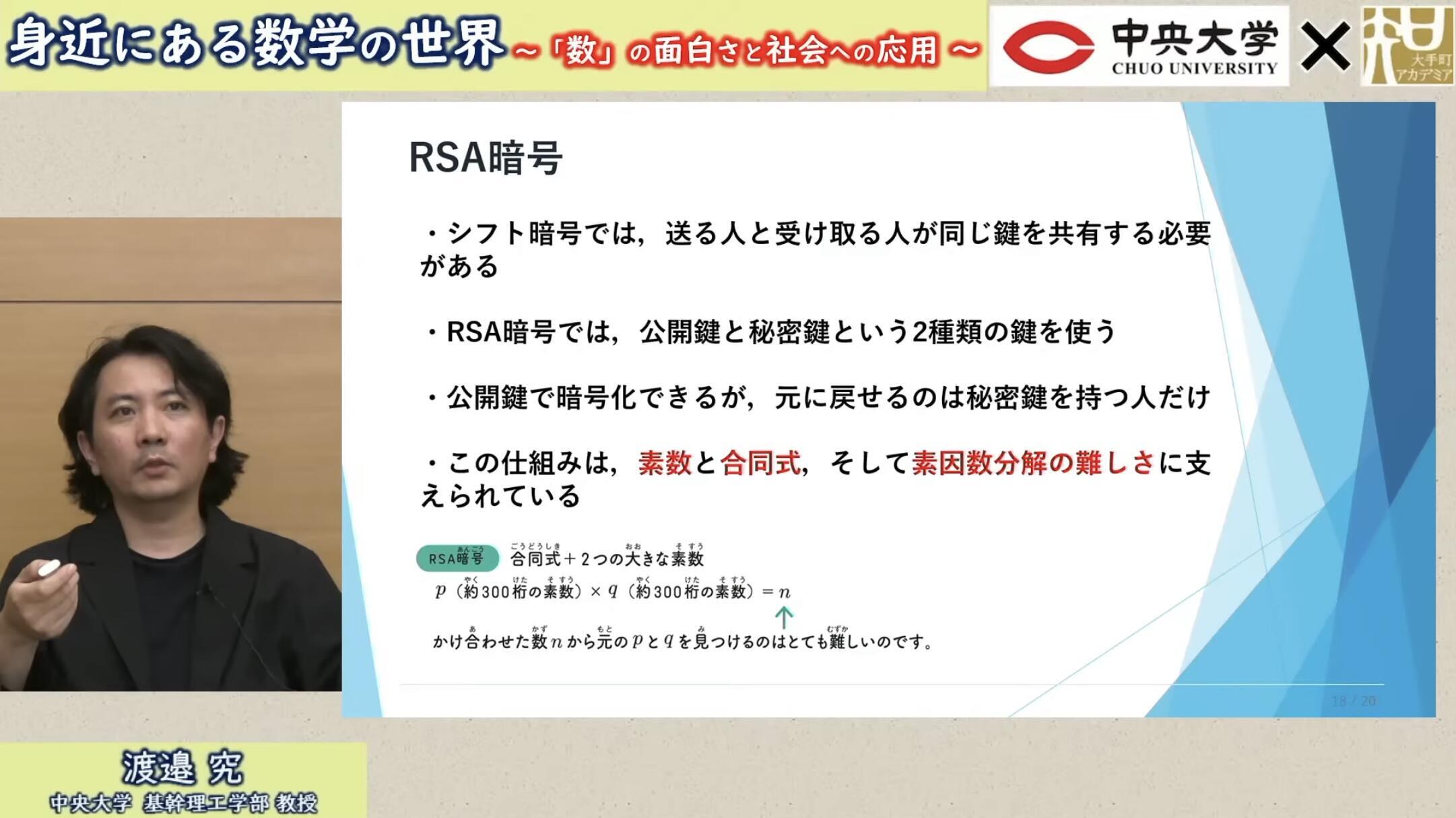
RSA cryptography, widely used on the internet for online shopping, online banking, and other services, is built using the properties of modular arithmetic and prime numbers. The security of RSA cryptography depends on the difficulty of "prime factorization," that is, finding the original prime numbers from a number obtained by multiplying very large primes together. Modular arithmetic and prime numbers are basic mathematical ideas that even high school students can understand. Even with today's computers, however, factoring a number obtained by multiplying two primes of about 300 digits each would take an enormous amount of time and would be difficult to complete within a practical timeframe.
Professor Watanabe concluded the lecture by emphasizing that, as in the case of RSA cryptography, mathematics is used in places we rarely notice, and that it supports aspects of our everyday lives.
Talk Session
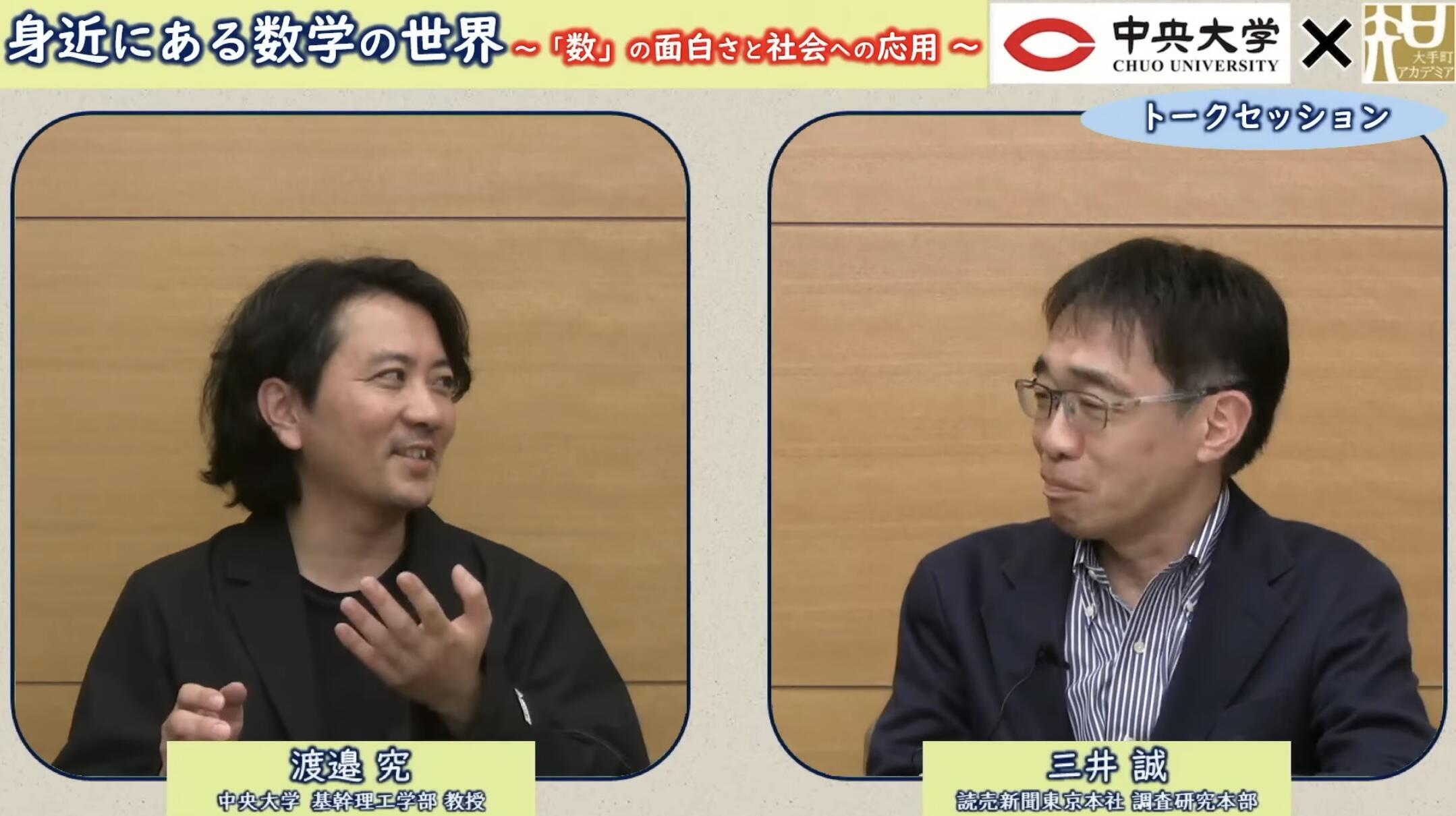
In the discussion session with Mr. Mitsui, the first topic was why so many people feel that they are not good at mathematics even though mathematics is familiar and useful.
Professor Watanabe explained that one major reason is that school arithmetic and mathematics gradually become more abstract. In the lower grades of elementary school, children deal with concrete numbers, but they eventually move on to fractions, decimals, algebraic expressions, and quadratic functions. As the objects they handle move farther away from their everyday intuition, many people may begin to find mathematics difficult.
He also noted that with subjects such as history and science, one can often focus on a favorite period or topic, whereas mathematics has a cumulative structure: once understanding becomes insufficient at some point, it becomes difficult to keep up with what comes next. He suggested that this cumulative nature of mathematics may be another reason many people find it challenging.
What Makes Mathematics Fascinating
Asked by Mr. Mitsui what he finds appealing about pursuing mathematics as a researcher, Professor Watanabe recalled his experiences in graduate school. He spoke of the excitement of working on a problem without knowing whether it could be solved, as if exploring in the dark in search of an exit, and of the thrill of being the first person in the world to discover a theorem. Those experiences, he said, remain a driving force behind his research today.
He also explained that although such research results may not immediately be useful to society, mathematics is a highly versatile discipline. If a wide range of mathematical results is accumulated as a reserve of knowledge, they may eventually be applied or put to practical use when the need arises. In this sense, he said, mathematics is a discipline that can contribute to society.
Mathematics in the Age of AI
The discussion also turned to AI, which has been advancing rapidly in recent years. Professor Watanabe noted that AI is evolving at a remarkable pace, including cases in which it has helped solve mathematical problems that had remained open for nearly 80 years. At the same time, he emphasized that humans still have an important role to play in deciding which problems are worth tackling. He predicted that, in the future, mathematicians with deep expertise will work with AI in their research and further expand the frontiers of knowledge.
Finally, when asked how children can become interested in mathematics or overcome the feeling that they are not good at it, Professor Watanabe said, "Forcing mathematics on them has the opposite effect; it is important to plant many seeds of interest." The aspects of mathematics people find interesting, and the timing at which that interest begins to grow, differ from one person to another. That is why it is important to provide children with various opportunities to encounter mathematics, such as giving them mathematics books that are not school textbooks or taking them to science museums and mathematics-related exhibitions. With this, the talk session came to a close.
A video of "Chuo University × Otemachi Academia, 13th Session: The World of Mathematics All Around Us: The Fascination of Numbers and Their Applications in Society," held on May 27, 2026, is available here.
Kiwamu Watanabe/Professor, School of Science and Engineering, Chuo University
Area of Specialization: Algebraic GeometryKiwamu Watanabe was born in Yokohama in 1984. In 2006, he graduated from the Department of Mathematical Sciences in the School of Science and Engineering, Waseda University. In 2008, he completed the Master’s Program in Mathematical Sciences in the Graduate School of Science and Engineering, Waseda University. In 2010, he completed the Doctoral Program in Mathematics and Applied Mathematics in the Graduate School of Fundamental Science and Engineering, Waseda University. He holds a Ph.D. in science. After serving as a JSPS Research Fellow for Young Scientists (DC1 and PD) at Waseda University, a JSPS Research Fellow for Young Scientists (PD) at the University of Tokyo, and Assistant Professor in the Graduate School of Science and Engineering, Saitama University, he was appointed as Associate Professor in the Faculty of Science and Engineering, Chuo University in April 2020. In April 2026, he was appointed as Professor in the School of Science and Engineering, Chuo University.
His current research focuses on the structure of algebraic varieties from the perspective of the positivity of tangent bundles and on the structure of Fano varieties. In recent years, he has also been actively engaged in outreach activities, including publishing lecture-related videos on YouTube and disseminating information through social media.
Homepage: https://sites.google.com/site/kiwamuwatanabeshomepage/
- Share articles


