

Inclusion and Exclusion: A Case Study of French Immigration Policy
Chihiro Nakamura/Associate Professor, Faculty of Economics, Chuo University
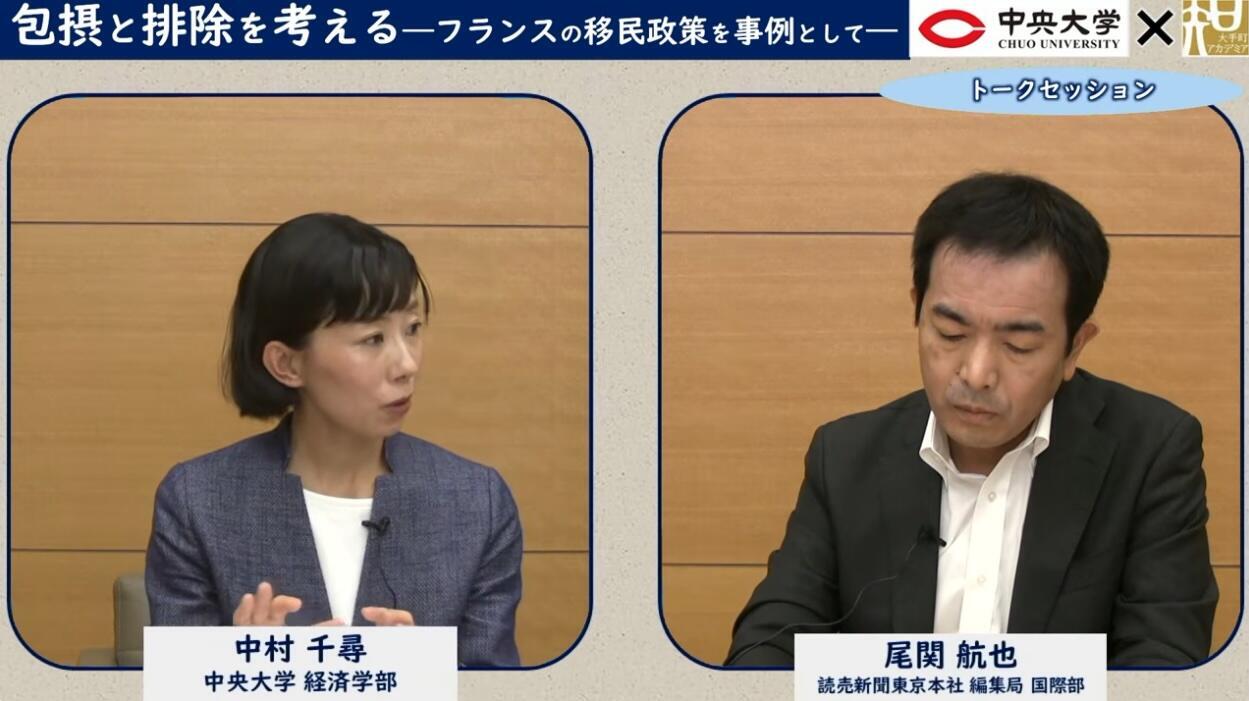
Speaker:Chihiro Nakamura(Associate Professor, Faculty of Economics, Chuo University)
Interviewer:Koya Ozeki(Senior Editor, International News Department, Editorial Bureau, Yomiuri Shimbun Tokyo Headquarters)
"Chuo University × Otemachi Academia" is a program that shares with the wider community the valuable knowledge Chuo University has cultivated throughout its history. The 14th session, titled "Inclusion and Exclusion: A Case Study of French Immigration Policy," was held on September 16. Against the backdrop of a growing foreign resident population in Japan, Associate Professor Chihiro Nakamura (Faculty of Economics, Chuo University) gave an online lecture on the history of France, one of the first countries to accept immigrants, focusing on the interwar period. In the subsequent talk session, Nakamura and Koya Ozeki (International News Department, Editorial Bureau, Yomiuri Shimbun Tokyo Headquarters) intensively discussed the implications of France's experience for Japan.
Overview of immigration to France
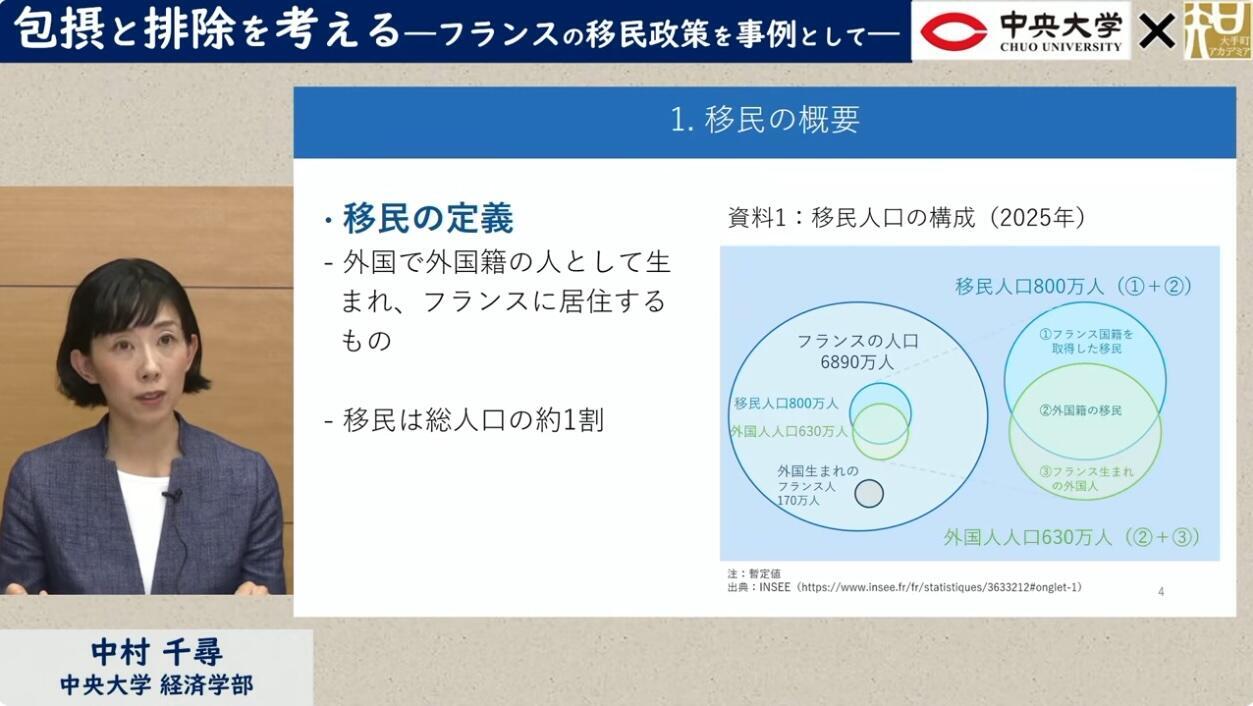
Associate Professor Nakamura commenced her lecture by outlining immigration to France. The proportion of foreign residents in G7 countries is around 10% to 20%. The figure for France is 11%, which is not exceptionally high among developed countries. Nevertheless, immigration has remained an important political issue in France, and the far-right National Rally, which advocates an anti-immigration platform, is expected to make gains in next spring's presidential election. Nakamura noted that although efforts to exclude immigrants have emerged, France has also seen initiatives to include them in society. She emphasized the importance of tracing the evolution of French immigration policy.
In France, the term "immigrant" refers to someone who was born abroad as a foreign national and subsequently came to live in France, regardless of whether they later acquired French citizenship. She also noted that second- and third-generation immigrants are statistically classified as nationals. This makes it difficult for the discrimination and exclusion experienced by such nationals to be captured in data.
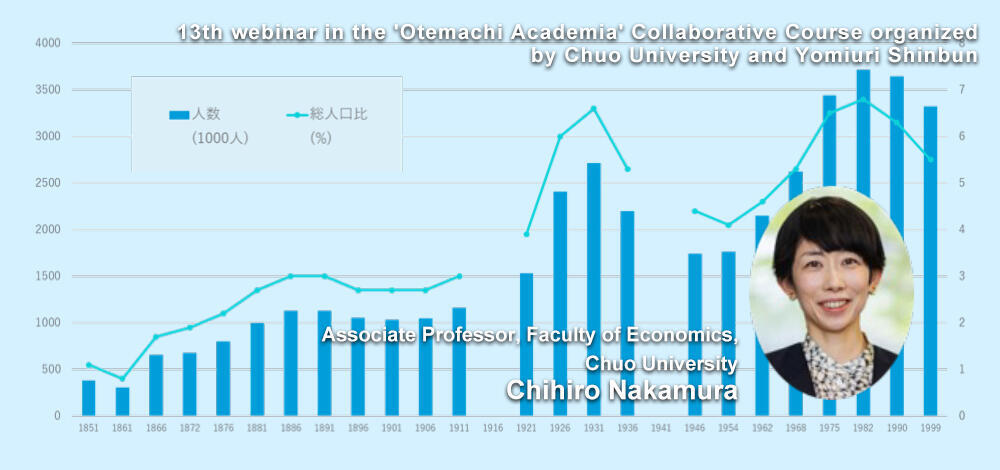
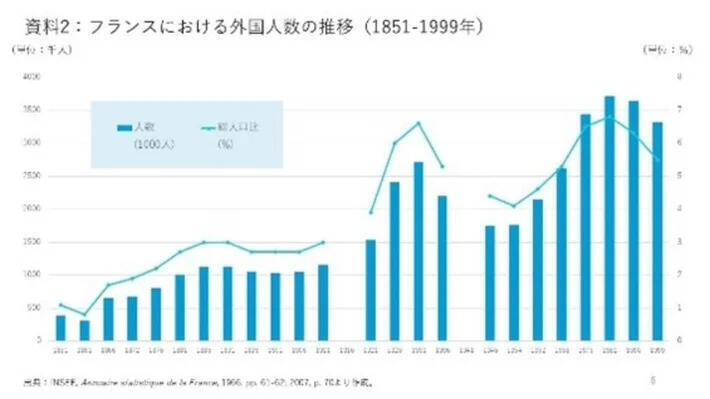
France first began collecting statistics on foreign nationals in the 1851 census, which recorded 380,000 foreign residents. Their numbers grew only gradually during the latter half of the 19th century, but rose sharply in the 1920s. They continued to increase after World War II until the early 1980s, and then declined temporarily before resuming an upward trend in the 2000s. In 2025, foreign nationals accounted for 9.1% of the population, the highest proportion since statistics were first collected.
Before World War II, most immigrants came from neighboring countries such as Italy, Belgium, and Spain, as well as other European countries such as Poland. After the war, many initially came from Southern European countries, including Spain and Portugal. However, over time, immigration from outside Europe increased. In particular, this increase came from North African countries that were former French colonies, such as Algeria, Morocco, and Tunisia.
Reasons for increased immigration in the 1920s
Associate Professor Nakamura explained that France had already been receiving more foreign nationals than neighboring countries since the latter half of the 19th century, but that World War I marked a major turning point. Nakamura noted that this war demanded the all-out mobilization of national resources. Workers and soldiers were brought in huge numbers from across Europe, from the colonies, and from China.
After the war, France entered a period of economic prosperity in the 1920s and faced a severe labor shortage. The government concluded bilateral agreements with countries including Poland, Italy, and Czechoslovakia. These agreements sought to facilitate the recruitment of foreign workers while establishing equal treatment for foreign and French workers. Separately from the government's efforts, private organization known as the Société générale d'immigration were established, primarily by Comité centrale des houillères de France. This company actively recruited workers from Poland, hiring 400,000 workers in the 1920s alone. As a result, the number of foreign nationals in France increased by more than one million in the 1920s.
However, Nakamura pointed out that the expansion of immigration during this period was not necessarily accompanied by adequate social inclusion. Equal treatment was intended less to protect foreign workers than to prevent competition with French workers. She explained that immigrants were essentially treated as a safety valve for the labor market during economic downturns.
Great Depression and postwar period
As the Great Depression took hold and unemployment began to rise in France around the autumn of 1930, the government restricted the admission of new immigrants. In August 1932, it enacted the Law on the Protection of National Labor, which set limits on the proportion of foreign workers that could be employed in different regions and occupations. This law established the principle that French workers should receive priority in employment.
In 1934, under government pressure, Polish workers in the coal mines of northern France were dismissed and sent back to Poland. Antoine de Saint-Exupéry describes their plight in Wind, Sand and Stars: families forced to return to a homeland they had left behind. Nakamura read a passage from the book to show how these immigrant workers were swept along by the currents of history.
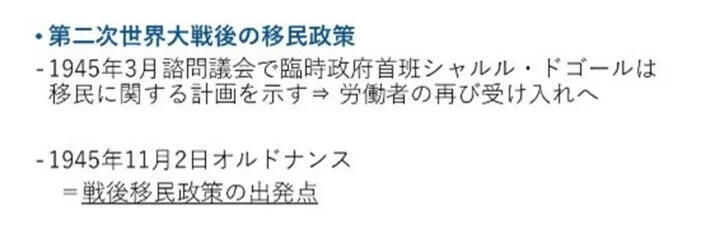
However, the need to accept foreign nationals as workers was once again recognized after World War II. Recruitment of foreign workers resumed in 1946, and bilateral agreements were concluded with Italy, Spain, and Portugal. In 1947, French citizenship rights were granted to Muslims in Algeria, and freedom of movement to mainland France was legalized. This led to a sharp increase in the movement of workers from Algeria.
Meanwhile, as France entered a period of rapid economic growth in the mid-1950s, more and more immigrant workers arrived and stayed without authorization. The government did little more than legalize their status after the fact. Postwar France also faced a severe housing shortage, and nothing was done to improve living conditions for these workers. As a result, slums known as bidonvilles sprang up on the outskirts of cities.
At the end of her lecture, Associate Professor Nakamura reflected on how French immigration policy had long targeted immigrants only as workers. Immigrant and foreign workers helped drive France's industrialization and modernization, she said, but it could also be argued that this progress was built on their exploitation. She concluded that a policy aimed first and foremost at filling labor shortages had, in some respects, lacked respect for immigrants as people, that is, an awareness of their human rights.
Talk session
During the talk session with Koya Ozeki, he asked what lay behind the growing support for far-right parties in contemporary France and where the historical turning points might have occurred. In response, Nakamura explained the rise of the far right, noting that multiple factors were intertwined and that it was difficult to pinpoint a single moment as the cause or identify a specific historical mistake. She described how, in a region known as the empty diagonal, where factory closures and relocations overseas followed the oil crises of the 1970s, population outflows and depopulation caused people to feel left behind. Losing faith in established political parties, these people shifted their support to far-right parties offering new policy agendas.
Nakamura also observed that, given the long history of routine migration between France and its neighboring countries since the 19th century, refusing to accept immigrants was never a realistic option. She argued that if France had closed its labor market, its postwar economic development would likely have been much slower.
Comparing France with Japan, she noted that the two countries share a pattern of expanding immigration to address labor shortages caused by declining birth rates and aging populations. She emphasized that improving the living conditions of foreign residents is also essential to enabling them to live without undue dissatisfaction and coexist with Japanese people. She added that although local governments have so far played the central role in implementing measures to promote coexistence, their efforts alone have limitations. The national government, local governments, businesses, and communities need to work together with a long-term vision.
Finally, Nakamura was asked what might happen if the far-right politician Marine Le Pen won next spring's presidential election. She said immigration policy could become even stricter. At the same time, she noted that France has kept admitting labor migrants since the Sarkozy administration, but only in occupations with labor shortages. This apparently contradictory mix of tightening restrictions and continuing to admit workers, she said, is a dilemma shared by developed countries and is likely to continue. With that, the discussion came to a close.
*A video of "Chuo University × Otemachi Academia, 14th Session: Inclusion and Exclusion: A Case Study of French Immigration Policy," held on September 16, 2026, is available here.
Chihiro Nakamura/Associate Professor, Faculty of Economics, Chuo University
After serving as an Associate Professor at Chiba University, Nakamura assumed her current position in April 2022.
Her area of specialization is French economic history.
Her major publications include The Limits of Pacifism: Attempts at International Cooperation and the Defense of the Fatherland, in Reconsidering the Causes of the Outbreak of World War I: International Division of Labor and Public Psychology (Tomoji Onozuka, ed., Iwanami Shoten, 2014) and more.
- Share articles


