

Heian-period Aristocracy and Jimoku
—The Formation of the Jimoku Protocols as Studies of the Imperial Court Nobility
Kanako Shimura
Associate Professor, Faculty of Letters, Chuo University
Area of Specialization: Ancient Japanese History
1. Heian-period aristocracy and jimoku
In the imperial court in the Heian period, numerous court ceremonies were held every day. Among these, one of the most important ceremonies for the Heian aristocracy was jimoku. Jimoku was the ceremony for appointing officials to government posts. Personnel matters have always been a topic of public interest, both in the past and present day. In The Pillow Book, a representative work of Heian literature, the clan of a person who failed to secure a post at jimoku is cited as an example of something disappointing-depicting the despair of a clan devastated by the outcome of the appointments. So, what kind of ceremony was jimoku?
2. What is jimoku?
Jimoku is an unfamiliar compound word, but the Kanji character "除" (jo) means appointing a government official or removing an old official and appointing a new one. In China, jimoku referred to an imperial edict appointing officials to office. Based on this, jimoku became established as the term meaning this ceremony from the Heian period onward. Until the Nara period, it was known as ninkan (having the same meaning).
Jimoku can be classified into two types: regular and special, with the regular ones held twice a year. Spring jimoku was called gekan jimoku or agatameshi jimoku (provincial official appointments), and autumn jimoku was called kyokan jimoku or tsukasameshi jimoku (capital official appointments); these were used to appoint officials of the fourth rank in government ministries and provinces, excluding ministers. While primarily provincial officials were appointed in gekan jimoku, it was customary to appoint capital officials at the same time. Gekan jimoku took place from the start of New Year through February or March and was also known as spring jimoku. Kyokan jimoku was originally held in February, but by the late Heian period, it was held from autumn through December and was also called autumn jimoku. Jimoku was a lengthy ceremony spanning three nights, with one of the most complex sets of protocols among the numerous court ceremonies. For this reason, the court noble serving as shuhitsu (the official in charge of presiding over the ceremony) was required to have a thorough knowledge on all the jimoku procedures.
3. Procedure of jimoku
Although the procedures for jimoku vary depending on the ritual manual, the outline of spring jimoku, discernible from major ritual manuals such as Saikyuki Hokuzansho and Gokeshidai, is as follows(1).
(1) On the previous day of the ceremony, the minister receives an imperial decree instructing geki (secretariats in the highest rank) and benkan (controllers/officials of the department of state) to convene jimoku. Necessary materials, including paper for ōmagaki (an appointment register in which names were entered into vacant posts as decisions were made) and rōchō (years of service of candidates), are prepared, and arrangements are made for the banquet.
(2) On the day of the ceremony, the ministers and other high-ranking officials move from jinnoza (the seats where officials assemble) to gisho (the council chamber). At the summons of kurōdo (chamberlain), the minister orders the secretariats in the highest rank to prepare a hakobumi (a box containing the stationery and documents necessary for jimoku). The minister in charge of presiding over the ceremony prepares necessary documents, including the appointment register on which the results of the appointments would be recorded, the register listing vacant positions, and mōshibumi (documents requesting appointment) that have been submitted in advance.
(3) Appointments are generally made in order of official rank, starting from the lowest positions to the highest. This sequence begins with sakan (clerks) and jō (secretary) of the provincial officials, followed by hangan (clerks) and lower-ranking officials in the capital, then kenkan (key lower-ranking officials) (such as geki, shi [general secretariat], and shikibu-no-jō [secretary of the Ministry of Rites]) and finally zuryō (provincial governors). Key lower-ranking officials and provincial governors are appointed through the kyo system, in which senior court nobles submit a list of names of individuals they deem suitable for vacant posts, and the Emperor makes the final decision.
(4) Every time an appointment is finalized, the minister in charge of presiding over the ceremony writes the name of the appointees and the reasons for the appointment in the blank spaces of the list of candidates. Once all appointments are completed, the document is presented to the Emperor (these appointments are made throughout the first, middle, and final watches of the night).
(5) On the final day, based on the returned appointment register, dainagon (counselor) and lower-ranking officials prepare meshina (a document listing the appointees, also known as the fair copy) and orina (a document listing the appointees in order of rank).
Thus, jimoku, held over three nights in the presence of the Emperor, involved various types of appointments and the detailed protocols associated with them, so the minister in charge of presiding over the ceremony required profound knowledge on the protocols.
Chart for reference: Seating layout (fusetsu) and related spaces for jimoku in the Heian Imperial Palace (dairi)
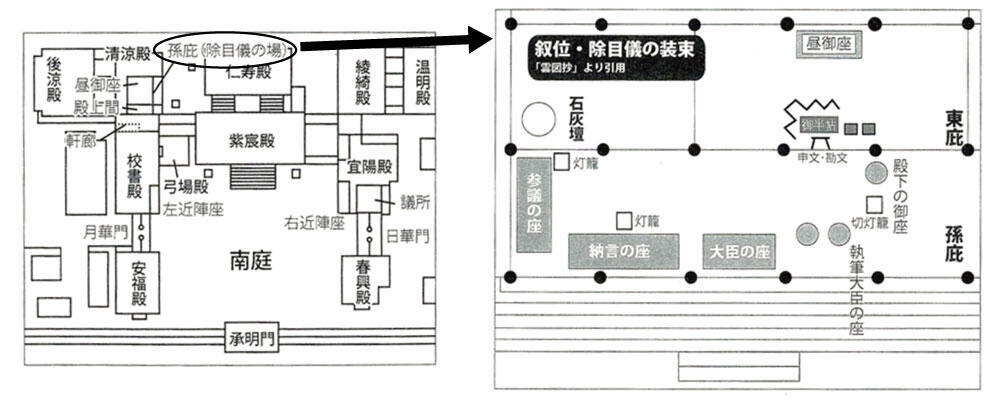
(Source: Exhibition Catalog of "Inaba and the Imperial Court: Governors of Inaba Province in the Heian Period," edited by the Tottori City Museum of History of the Tottori City Cultural Foundation, 2016)
4. Glimpse of jimoku
The Shoyuki, a diary of Fujiwara no Sanesuke (957-1046), a prominent statesman of the Heian period, includes an article dated January 23, 1013 (the second year of the Chōwa era) that records the proceedings of agatameshi jimoku which was presided over by Fujiwara no Michinaga, the Minister of the Left (sadaijin) at the time.
二十三日、乙卯、内に参る〈未一点〉。陣頭に卿相無し。(中略)しばらくして、内大臣参入す。その後、左大臣、陣に着きて云はく「議所に着かざるは如何」てへり。蔵人左兵衛尉敦親、諸卿を召す。大臣、大外記敦頼を召し、筥書を侍らしむべき由を仰す。即ち外記四人、筥書を捧げ、日華門より入り、宜陽殿の南第一間に立つ。(中略)外記、筥を捧げ、南殿の下を経ること、昨の如し。左大臣云はく「是れ降雨の事なり。晴時のごとく参入すべし」てへり。〈此の間、天晴る。〉よりて外記、南より参入し、射場の砌に立つ。外記、若し晴儀を用ゐるは、また晴に立つべきか。今日の事、駮白なり。時宜に随ふか。
Due to space constraints, details of the ceremony have been omitted; however, it is clear that every step--from the gathering of participants to instructions given to the administrative staff, and even the handling of the boxes used during jimoku--was conducted in strict accordance with detailed ceremonial protocols. Furthermore, it is evident that at the beginning of the ceremony, sadaijin Fujiwara no Michinaga expressed concern that the participants had not followed the prescribed procedure regarding their arrival at the council chamber. Heian aristocrats placed great importance on conducting ceremonies according to precedents, making them highly sensitive to any deviation from the norm. However, in the following passage, although the procedure for rainy weather was used due to the rain, an instruction was issued to proceed according to the procedure for clear weather. In response, dainagon Fujiwara no Sanesuke, recorded a critical remark, stating that the day's jimoku should be strictly scrutinized (because Michinaga's instruction deviated from customary practice).
In this way, the protocols of jimoku had to be strictly conducted, and eventually, a detailed manual was compiled to ensure jimoku would conducted smoothly and without hitch. These protocols were then passed down to future generations and preserved as kojitsu (established customs to be followed as models for future practice).
5. Jimoku as a study of imperial court nobility
Not only regarding jimoku but also concerning the annual events and ceremonies of the Heian period, a body of oral traditions and established customs, which might be termed "kugyō-gaku (the study of imperial court nobility), was established. The development of these customs among the aristocracy began with Fujiwara no Mototsune (836-891), was systematized during the time of Fujiwara no Tadahira (880-949), and led his sons, Fujiwara no Saneyori and Fujiwara no Morosuke, to establish the Ononomiya School and the Kujō School, respectively(2). The established customs accumulated within each clan became the basis for the aristocracy's administration of state affairs. Subsequently, the Kujō School incorporated ceremonial traditions inherited by imperial descendants and princes who had been transferred from the imperial lineage such as Emperors Uda and Daigo, thereby forming the customs of the Mido School by Fujiwara no Michinaga(3). The established customs by the main line of the regent of the Mido School, which were passed down orally, were inherited by Fujiwara no Tadazane (1078-1162) and eventually inherited by Fujiwara no (Kujō) Kanezane. The customs regarding jimoku were then compiled into writings such as the Haru Jimoku Shō during the reign of Fujiwara no Yoshitsune (1169-1206), the son of Fujiwara no (Kujō) Kanezane.
Even after the medieval period, when the core of governance was passed to the warrior class, jimoku continued uninterrupted, although its substantial meaning had been lost. By the 14th century, numerous records dating back to the Heian period--including jimoku-sho (documents detailing the procedures of jimoku), documents requesting appointment, and appointment registers--were compiled into Gyorogusho and Gyorogubetsuroku, edited by Tōin Kinkata. Jimoku, based on the traditions of each clan, served as a demonstration of their identity as court nobles supporting the imperial court, and was thus preserved as one of the important bodies of irreplaceable knowledge.
(1) Based on works such as History of the Emperor, Vol. 3: The Emperor and the Regents by Sasaki, K., (Kodansha Academic Library Series, 2018).
(2) Takeuchi, R., Oral Traditions and Instructions: Genealogy of Kugyōgaku (Prior to the Formation of the Secret Oral Traditions) (in Collected Works of Rizo Takeuchi, Vol. 5, Kadokawa Shoten, 1999; originally published in 1940).
(3) Tajima, I., A Study of the Genealogy of Kugyōgaku: Formation and Transmission of Court Deliberation Procedures, Secret Oral Traditions, and Customs in Aristocratic Society during the Heian and Kamakura Periods (In Studies in the Imperial and Aristocratic Archives, Series 3, edited by Tajima, I.: Shibunkaku Publishing, 2009).
Kanako Shimura/Associate Professor, Faculty of Letters, Chuo University
Area of Specialization: Ancient Japanese HistoryKanako Shimura was born in Tokyo. She graduated from the Department of Cultural History, Faculty of Letters, Doshisha University in 2004. In 2007, she completed the Master’s Program in history in the Graduate School of Arts and Letters, Meiji University. In 2012, she completed the Doctoral Program in history in the same graduate school and was awarded a Ph.D. in History. After serving as Associate Professor in the Institute of Education, Shinshu University, she assumed her current position.
Her primary research includes the structure of ancient Japanese royal palaces, as well as government affairs, imperial court procedures, and court music (gagaku) performed during ceremonies.
Her major publications include Structure of Ancient Japanese Royal Palaces and Their Administrative and Ceremonial Functions (Hanawa Shobo, 2015), Sanjonishi Clan Manuscript Collection of Jimoku Documents Held by the Meiji University Library (co-authored; Yagi Shoten, 2021), and more.
- Share articles


