

Analyzing Cultural Policy through Legislative Debate Records
Haruka Watanabe/Assistant Professor, Faculty of Global Informatics, Chuo University
Areas of Specialization: Socioinformatics and Cultural Policy Theory
1. Decision-making processes in cultural policy
Do you know who operates the cultural facilities in your community? When people hear the term "cultural policy," they often think of government initiatives such as building cultural facilities and museums or supporting artists. However, cultural policy is not simply a mechanism for supporting forms of arts and culture whose value can be taken for granted.
In recent years, cultural policy has increasingly focused on the instrumental role of culture in achieving other policy objectives, including tourism, community development, international exchange, social welfare, education, and industrial development[i]. At the same time, a great body of research has also advanced on the evidence used to justify cultural policy, including evidence concerning the broader impacts across these policy domains[ii]. Yet cultural policy is not simply a matter of supporting arts and culture on the assumption that they are inherently valuable. Rather, it is an ongoing process of making value judgments about what should be supported, who should receive support, and why. How, then, can we study decision-making in cultural policy as multilayered and dynamic processes?
2. Text analysis of legislative debate records
To explore this question, I have been conducting text analysis of legislative debate records. The value judgments involved in policymaking are reflected not only in policy documents and institutional design, but also in the statements made and issues debated in legislative assemblies. Although the role and composition of legislative bodies vary, legislative discourse provides a window into how policies and institutions have been framed, debated and justified.
Legislative debate records are not verbatim records of what bureaucrats and politicians say; rather, they are official records that have undergone editing and verification. Even so, political science and the social sciences has applied text-as-data approaches to official legislative debate records, alongside political speeches, newspaper articles, and administrative documents[iii].
The study of the statements made by political officials and politicians is by no means limited to computational text analysis. For example, the policy scholar Giandomenico Majone argued that "public policy is made of language," viewing policymaking not simply as a matter of rational choice or technical judgment, but as a process in which policies are legitimized through arguments based on evidence and persuasion[iv]. Although my own research focuses on institutions and policies relating to culture and the arts, I do not regard them as fixed or self-evident entities of study. Rather, I examine them as constructs that are shaped through discourse in legislative discourse. From this perspective, legislative discourse can be understood not only as official records of legislative debate, but also as an arena in which the meaning and legitimacy of policies and institutions are constructed.
3. Examining an example of policy debates in regional cultural policy
Let us consider the designated manager system (DMS) for cultural facilities and theaters as an example. In Japan, many cultural facilities and theaters established by local governments are operated not directly by the local governments themselves, but by private companies, foundations, nonprofit organizations (NPOs), and other entities. This arrangement stems from the DMS, introduced through the 2003 revision to the Local Autonomy Act, which allows private-sector management methods to be incorporated into the operation of public facilities.
The DMS was introduced for public facilities with the objectives of reducing costs and improving services. Because the designation of a manager requires approval by the local assembly, the importance of legislative involvement and oversight has consistently been emphasized. Cultural facilities, in particular, are expected not only to achieve financial efficiency but also fulfill broader public purposes such as supporting local cultural activities and maintaining the specialized personnel to deliver services. Consequently, debates in local assemblies over the operation of the DMS have consistently focused on how best to balance efficiency with the purpose of the cultural facilities.
An analysis of statements made by members of prefectural assemblies concerning the DMS reveals, through correspondence analysis of word usage, that the structure of these debates has changed over time (Figure 1)[v]. In the early years following the introduction of the DMS, discussions centered on issues relating to its underlying rationale; specifically, questions such as "Who should operate these facilities?" and "Why should management be entrusted to the private sector?" Subsequently, the focus shifted from administrative concerns such as evaluation and accountability toward the functions and operational capacity of cultural facilities themselves, including topics such as theaters and human resources. More recently, issues concerning the sustainable operation of cultural facilities have become more prominent. These issues include fees, contracts, and revenue. Attention is also being directed to connections to other policy areas, including tourism. In this way, analysis of legislative debate records enables us to identify which aspects of the DMS have been regarded as matters of concern in cultural policy debates, while also shedding light on who raised these issues and when they entered legislative debate.
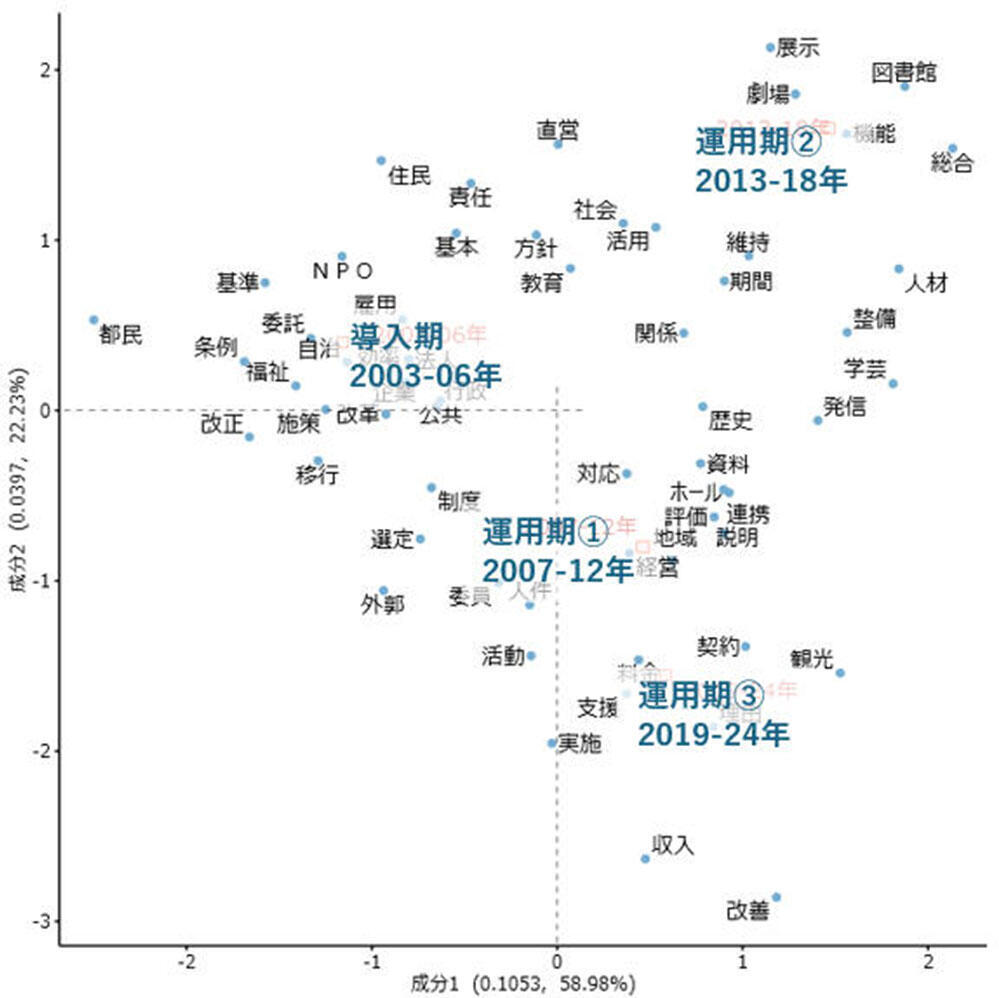
Figure 1. Correspondence analysis of statements by prefectural assembly members
on the DMS (by time period)
4. Future research: Generative AI and the analysis of legislative debate records
However, it is by no means easy to identify and analyze points of debate from the enormous volume of legislative debate records in a way that avoids arbitrary selection. Until now, the analysis of texts relating to politics and public policy has relied on dictionaries, statistical methods, and machine learning models. In recent years, however, the use of large language models (LLMs) has expanded rapidly alongside these approaches. LLMs can assist with context-aware text summarization, classification, and the estimation of the speakers' stances, thereby supporting more fine-grained analyses of legislative discourse.
More recently, the emergence of AI coding agents such as Codex and Claude Code have made it increasingly feasible for researchers who previously faced technical barriers to large-scale text analysis to collect, preprocess, summarize, classify, and aggregate textual data through natural language instructions. In my own research, I use AI agents to perform parts of the aggregation and visualization of legislative debate data. Through this process, I have found that tasks which would otherwise take considerable time if coded manually from scratch can now be prototyped and tested relatively quickly. At the same time, I have also come to recognize that researchers must still return to the original legislative debate records to verify the appropriateness of search terms, the relevance of extracted statements, and the interpretation of summarized results. Furthermore, generative AI can assist in organizing the key issues contained in vast collections of text and suggest which passages for closer examination or for further analysis. Nevertheless, careful consideration is needed regarding the extent to which researchers should rely on such tools. Going forward, I intend to more closely examine both the potential and the challenges of using generative AI to analyze legislative discourse.
[i] Agency for Cultural Affairs (2023), Basic Plan on the Promotion of Culture and the Arts (Second Phase): Creating Value and Revitalizing Society and the Economy (Cabinet Decision, March 24, 2023), Agency for Cultural Affairs. Subtitle translated by the author; official English title follows the Agency for Cultural Affairs.
[ii] A comprehensive study that summarizes evidence relating to cultural policy is as follows. Crossick, Geoffrey and Patrycja Kaszynska (2016), Understanding the Value of Arts & Culture: The AHRC Cultural Value Project, (Japanese translation by Mia Nakamura (2022), Geijutsu bunka no kachi towa nanika: Kojin ya shakai ni motarasu henka to sono hyōka, Suiyosha Publishing).
[iii] A representative work is as follows. Grimmer, Justin, Margaret E. Roberts, and Brandon M. Stewart (2022), Text as Data: A New Framework for Machine Learning and the Social Sciences, Princeton University Press.
[iv] Majone, Giandomenico (1989), Evidence, Argument, and Persuasion in the Policy Process, Yale University Press, (Japanese translation by Tsunao Imamura (1998), Seisaku katei-ron no shiza: Seisaku bunseki to giron, Sanreishobo Publishing).
[v] The figure was created using KH Coder with partial modifications by the author. The analysis is based on the following conference presentation: Watanabe, H. (2025), "A Preliminary Study of Statements by Local Assembly Members on the Introduction and Operation of the Designated Manager System for Public Cultural Facilities," Proceedings of the 2025 Annual Conference of the Society of Socio-Informatics. This presentation was supported by JSPS KAKENHI Grant Number 23K12068.
Haruka Watanabe/Assistant Professor, Faculty of Global Informatics, Chuo University
Areas of Specialization: Socioinformatics and Cultural Policy TheoryHaruka Watanabe was born in Ehime Prefecture. She graduated from the Faculty of Letters, Kyoto University in 2010. She completed the Master’s Program in the Graduate School of Interdisciplinary Information Studies, the University of Tokyo in 2012. After advancing to the Doctoral Program at the same graduate school, she received a Ph.D. (Socio-Information and Communication Studies) in 2020. After holding positions such as Assistant Professor in the Institute for Advanced Social Sciences, Waseda University and Senior Research Analyst for grant activities at the Japan Arts Council, she assumed her current position in 2024.
Her research specializes in cultural policy and the management of cultural facilities within the field of socioinformatics. In particular, she focuses on how institutional frameworks and policy issues concerning culture and the arts have been discussed, using text analysis of legislative debate records from Japan and other countries.
Her major publications include Governance Theory of Public Cultural Facilities: The Practice and Shift of Local Governments’ Accountability, 2023, Waseda University Press.

- Share articles


