

Root Cause of the Structural Stagnation Before the Distribution of Electric Vehicles
―Examining Green Marketing Myopia Caused by Environmental Value and Experience Value
Takao Nomakuchi/Professor, Faculty of Global Management
Areas of Specialization: Humanities & Society, Business Administration, and Strategic Management
Introduction: Essence of the stagnation in the EV market
As a trump card for achieving carbon neutrality, the distribution of battery-powered electric vehicles (EVs) has been promoted strongly around the world, but it is now faced with a significant stagnation. Due to the huge subsidies provided by national governments and the green marketing of enterprises highlighting the contribution to the Earth environment as environmental value, the shift to EVs was considered as an inevitable trend around 2022.
However, the recent market data indicate the steep slowdown of that scenario. In the U.S., the sales quantity of EVs increased by only 7% between 2023 and 2024, showing a significant drop in growth rate at 50% between 2022 and 2023. In Europe, too, Volkswagen (VW) in Germany considered the closure of a domestic factory for the first time since the inauguration of business. Like this, the adverse trend is affecting the industrial field.
This stagnation can be observed also in the Japanese market. The market share of EVs in Japan passed a peak around 2022, and has been declining since then. As of March 2025, the sales share of EVs stood at 2.45%, showing a significant drop from 3.17% in the same month of the previous year. Most of previous studies discussed technical constraints, such as the shortage of recharging infrastructure and the maximum travel distance without refueling, and the uncertainty of political measures as factors in the stagnation. Meanwhile, this paper approaches this issue from the viewpoint of marketing theory. Concretely, this paper discusses whether or not enterprises fell into green marketing myopia, which means that the current promotion of EVs puts emphasis on environmental symbolic value too much while disregarding the long-term, practical customer value among consumers, and greenwashing, which is superficial advertisement.
In this discussion, Quantitative Survey Targeted at 169 General EV Users in Japan and Qualitative Survey Targeted at Commercial Drivers in the U.S. Research Triangle Park (RTP), which were conducted by the author, et al., are integrated, and the details of the chasm faced by the EV market before becoming mainstream are elucidated from a structural viewpoint.
First discussion: Causes of decrease of general users in the Japanese market
In order to clarify the mechanism for stagnation in distribution of EVs, the author, et al. first carried out a questionnaire survey targeted at 169 BEV users in Japan. Out of them, 116 users (68.6%) answered "I want to purchase an EV again," and as many as 53 users (31.3%) answered "I won't purchase an EV anymore." The existence of such unsatisfied users, who make up about 30%, is a direct factor in decreasing the market share of EVs.
- Based on these data, the author conducted multiple regression analyses stepwise with IBM SPSS 28, and extracted factors in evoking users' willingness to purchase an EV again and unwillingness to repurchase it. Factors in evoking the willingness to purchase an EV again among 116 users: while "the stance toward environmental activities" produces an extremely strong positive effect (β = 0.520), the evaluation of costs or convenience does not produce a significant effect.
- Factors in evoking the unwillingness to purchase an EV again among 53 users: "burdens of costs for environmental conservation" (β = 0.494) and "a feeling of security on the maintenance costs for gasoline vehicles" (β = 0.310) produce a strong positive effect. The inexpensiveness of electricity does not serve as an attractive feature, and the doubt about the environmental friendliness of EVs (β = 0.226) was significantly detected, too.
The user composition indicated by the analysis results is clear. The repeat users of EVs are genuine green consumers, who are deeply aware of environmental issues, and they choose EVs regardless of costs. On the other hand, users who stop driving an EV, who account for about 30%, become concerned about total costs, including environmental conservation costs and maintenance expenses, compared with the costs for gasoline vehicles, after actually owning an EV. The short-sighted economic merit of the inexpensiveness of electricity advertised by makers is totally offset by the burdens of total costs for daily operation.
Second discussion: Collapse of the exit strategy in the used car market
General users become concerned about total costs, because of a sharp fall in its value in the used car market, which is the exit of the lifecycle of an EV. The ratio between new cars and used ones in the Japanese automobile market is around 4:6, so the majority of customers who put importance on actual benefits purchase cars in the used car market.
However, the trade-in price (residual value ratio) of an EV in the actual distribution market indicates a surprising gap between EVs and gasoline vehicles (Table 1).
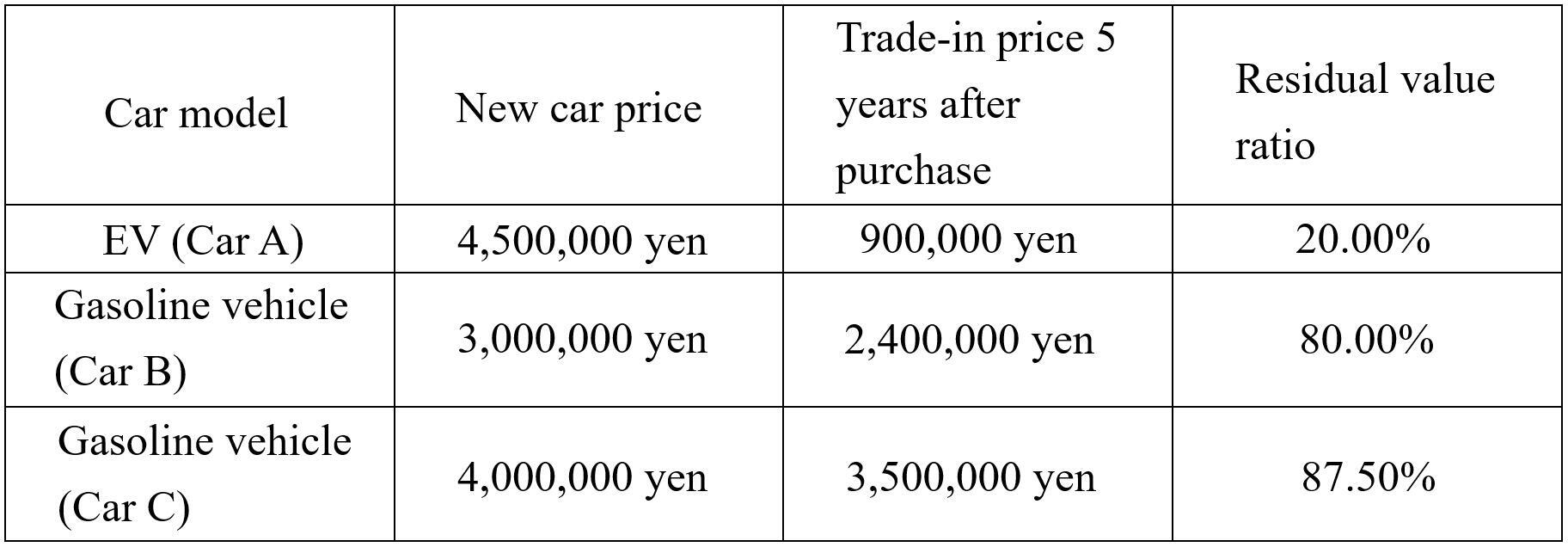
Table 1: Comparison of the trade-in prices (residual value ratios) after 5-year use
While gasoline vehicles have a high residual value ratio of over 80% five years after purchase, the residual value ratio of EVs drops steeply to only 20%. The major cause of the loss of asset value is the structural risk of costs for replacing batteries. If a used EV user wants to replace a general 24-kWh battery with a new one, the user has to prepare for paying at least 1.32 million yen, including costs for parts amounting to around 1.18 million yen (tax excluded) and labor charges. There is an astronomical gap, as it costs only 20,000 to 40,000 yen to replace the old battery of a gasoline vehicle with a new one.
No matter how much automobile manufacturers make the impression that new EVs are environmentally clean, their value becomes nearly zero five years after purchase, and users need to bear huge expenses for battery replacement. Considering this fact, it is inevitable that reasonable consumers will hesitate to purchase an EV again. The current measure for popularizing EVs, which advertises only short-term superficial merits and does not explain their substantial lifecycle cost, is considered by consumers as a kind of greenwashing.
Third discussion: Breakdown of the time-axis gap indicated in a survey of the U.S. RTP
In order to delve into the quantitative cost barrier in Japan, the author, et al. conducted a semi-structured interview and a qualitative data analysis (QDA) targeting drivers of ride-sharing cars for business use in the Research Triangle Park in North Carolina, the U.S. This region is a broad area connecting colleges and the international airport, and a driver drives a car 300-500 km/day. They belong to the leading indicator segment, because they experience the deterioration of performance of an EV and burdens for operation several times earlier than general users.
In this qualitative survey, EV drivers all commented, "I will certainly purchase a gasoline vehicle next time," showing a strong willingness to stop driving an EV. The process of a decline in their experience value (daily experience of actual use) is composed of the following 6 phases according to travel distance.
- Initial phase (0-10,000 km): Drivers are satisfied with the quietness and outstanding acceleration of a new car, and their experience value reaches a peak.
- Inconvenience comes up to the surface. (10,000-30,000 km): In hard operation where an EV must run 300-500 km per day, each driver must wait for rapid recharging two to four times a day. The suspension of business for recharging directly leads to the loss of opportunities (a decline in revenue), and stress builds up inside each driver.
- Drivers experience the deterioration of performance. (30,000-50,000 km): The deterioration of batteries accelerates through repeated rapid recharging, and the maximum travel distance after recharging decreases 30-40% from the distance written in a catalogue. In particular, in the cold environment in winter, it drops to around 150 km, making it impossible to do business with an EV.
- Decrease in economic efficiency (50,000-80,000 km): The loss of working hours due to recharging time and the augmentation of costs due to the decline in battery performance accumulate, and EVs' economic advantage over gasoline vehicles disappears totally.
- Users become worried about batteries (80,000-100,000 km): As the total travel distance of an EV gets closer to 100,000 km, the driver becomes concerned about the risk of unexpected system failure and a steep drop in the trade-in price of the EV. Accordingly, its psychological value becomes zero.
- Decision to stop driving an EV (around 100,000 km): Users deepen a sense of distrust in EV systems, and choose to switch to a gasoline vehicle.
The most important theoretical finding from this qualitative analysis is the structural trap called temporal asymmetry of the time axis of environmental value and experience value.
As mentioned in the carbon footprint report of Volvo and other documents, an enormous volume of CO2 is discharged during the process of manufacturing EVs, especially their batteries. Under the assumption of the general power mix depending on thermal power generation, the cumulative CO2 emissions from EVs fall below those from gasoline vehicles and true environmental value emerges only after travel distance reaches 50,000-100,000 km. Namely, there is a substantial gap that hinders the distribution of EVs (Figure 1).
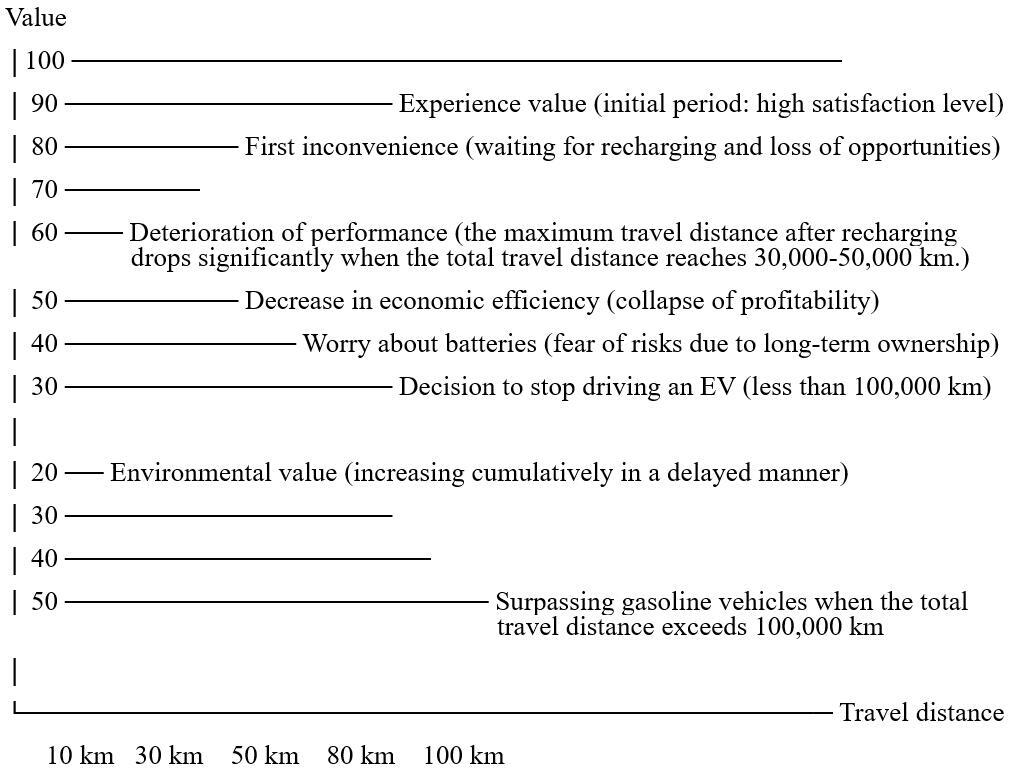
Figure 1: Integrated gap model for experience value and environmental value of EVs
Namely, long before the environmental value of EVs emerges in a delayed manner and exceeds that of gasoline vehicles (50,000-100,000 km)―(value arises when EVs run 10,000-30,000 km and reaches a tipping point at 50,000-80,000 km)―experience value, which indicates the reality of daily life, degrades rapidly, and then users stop driving an EV. The current green marketing is seriously myopic, as it causes a misunderstanding that the theoretical environmental value emerges immediately, while ignoring the time lag.
Conclusion: Breaking away from myopia and issues to be addressed
It can be proved, based on two research results mentioned in this paper, that the stagnation in the current EV market is not merely the temporary issue of weakening of consumers' environmental awareness, but a structural phenomenon caused by the temporal error in value design.
Consumers handle automobiles, which are expensive durables, according to the current reality, including daily maintenance costs, recharging burdens, and asset value. The marketing strategy that promotes drivers to purchase an EV again by advertising the future abstract value (reduction of CO2 emissions in LCA), despite the disappearance of current real value, is not reasonably feasible.
In order for the EV market to overcome the chasm to evolve from a market filled with first-time users to a mainstream market where practical benefit is prioritized, it is indispensable to drastically redesign marketing strategies and popularization measures. Policymakers have to break away from myopic incentives, such as temporary subsidies for purchasing a new car, and focus on the entire process of usage and the reduction of economic burdens as an exit strategy, by supporting the stabilization of residual value ratio in the used car market and reducing battery replacement expenses.
Automobile makers should stop advertising ideal numerical values on a catalogue and exaggerating the eco-friendliness of EVs, disclose the data on performance deterioration through actual running in a highly transparent manner, and develop next-generation durable batteries for supporting the experience value of heavy users. In order for EVs to take root in society broadly in the true sense, it is necessary to eradicate the myopia under the slogan of environmental value and switch to sincere long-term value design while prioritizing experience value that can be felt in each user's daily life.
[Reference]
- Ottman, J. A., Stafford, E. R., & Hartman, C. L. (2006). Avoiding Green Marketing Myopia. Environment, 48(5), pp. 22-36.
- Moore, Geoffrey A. (1991). Crossing the Chasm. HarperBusiness.
Takao Nomakuchi/Professor, Faculty of Global Management
Areas of Specialization: Humanities & Society, Business Administration, and Strategic ManagementTakao Nomakuchi graduated from Faculty of Economics, Keio University. After working for AFLAC (management planning and others), he engaged in actual tasks, such as formulation of strategies and organizational reform, at leading consulting firms, including Deloitte Tohmatsu Consulting, SAP Japan, and Ernst & Young. While working, he obtained a Master’s Degree in jurisprudence and international accounting at Chuo University and a Doctoral Degree in management systems at a graduate school of the University of Tsukuba. He assumed his current position in April 2019.
He specializes in strategic management, innovation theory, and digital transformation (DX). By fusing the profound knowledge of business practices and academic approaches, he engages in research and education regarding issues with business administration in the present age.
- Share articles


