
SPECIAL INTERVIEW
Logisnext’s Endeavor
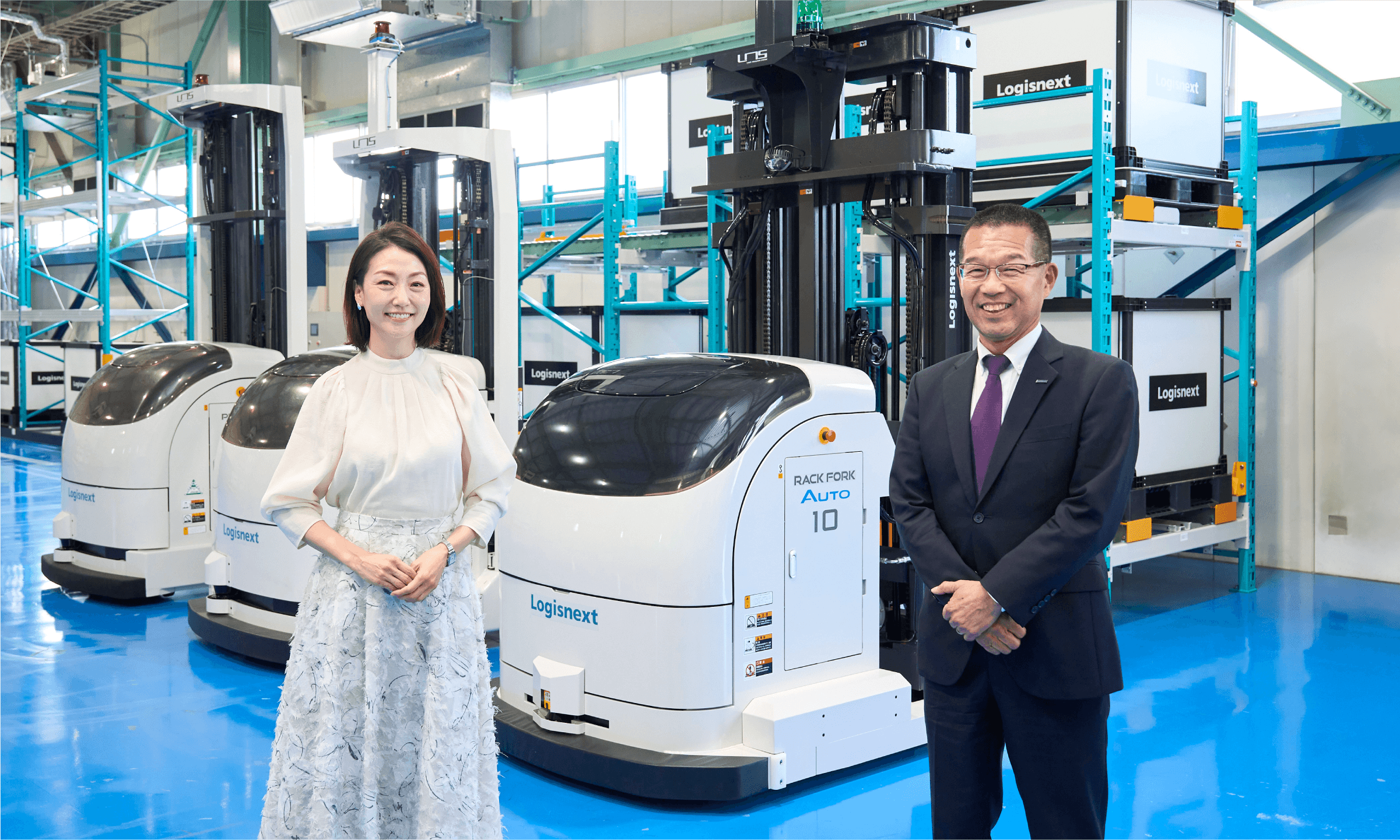
-
He graduated from the Faculty of Social Sciences at Hitotsubashi University in 1986 and joined Mitsubishi Heavy Industries, Ltd. In 2013, he became Director, Senior Executive Officer, and Head of the Corporate Planning Office at Mitsubishi Nichiyu Forklift Co., Ltd.; in 2014, he was appointed as Representative Director and President of Mitsubishi Caterpillar Forklift Europe B.V.; and in 2020, he became Senior Executive Officer and Head of the Overseas Business Headquarters at Mitsubishi Logisnext. He has held his current position since 2022.
-
She was born in Los Angeles, California, and raised in Osaka. After working as an announcer at Mainichi Broadcasting System, Inc. and as a news caster for “NEWS ZERO,” she has not only reported the news, but also conducted numerous interviews with politicians, celebrities, and Hollywood actors/actresses, as well as covering stories both in Japan and overseas. She also gives lectures on communication and related topics.
A global leader and pioneer
in electrification
Mr. Mano: Our origins date back to 1937, when Nippon Yusoki was established in Nagaokakyo, Kyoto, with the aim of contributing to Japanese industry by utilizing the storage batteries produced by Japan Storage Battery Co., Ltd. (present: GS Yuasa Corporation), which was established by Shimadzu Corporation in Kyoto by spinning off its battery business. Subsequently, following mergers with Mitsubishi Nichiyu Forklift and Unicarriers (under the name Mitsubishi Logisnext), the company was renamed “Logisnext” on April 30, 2026. We are the second-largest general logistics equipment manufacturer in Japan and the fifth-largest in the world in terms of sales.
Ms. Yagi: You have steadily grown your business while honoring the origins of the storage battery business, haven’t you?
Mr. Mano: Since forklifts operate in fixed locations and can be charged regularly, their electrification has progressed more rapidly than that of automobiles. In the global forklift market, electrified forklifts account for over 70%. The technological expertise that pioneered this transition has been inherited.
Ms. Yagi: Your company was truly a pioneer. Now, as a global company, you have bases worldwide and sell your products globally.
Mr. Mano: Outside Japan, we have factories in the United States, Finland, Spain, China, and Thailand. Our products, tailored to the needs of each country and region, are sold in more than 100 countries worldwide. We have approximately 11,000 employees globally. Our annual sales total approximately 660 billion yen worldwide, with 70% coming from overseas and 30% from Japan.
Addressing decarbonization
and labor shortages
with technology
Mr. Mano: Our battery-powered transporting vehicles were originally adopted at Tsukiji Market. At Toyosu Market, which opened in 2018, battery-powered transporting vehicles, which balance environmental considerations and convenience, were adopted for all vehicles, and approximately 1,400 of our units are currently in operation.
Ms. Yagi: I hear that your company was the first in the world to develop an unmanned (automatic) forklift.
Mr. Mano: In 1971, we developed a magnetic induction-guided unmanned forklift. At the time, it was still unclear whether there was a need for automation.
Ms. Yagi: That really shows foresight, doesn’t it?
Mr. Mano: Automation is still in developing with the high interest in the industry. Initially, magnetic guidance systems required floor modifications, but today, laser guidance systems, which require no such modifications and allow for flexible warehouse layout changes, have become widespread. Unmanned forklifts equipped with AI cameras and sensors are operating with vision similar to that of humans.
Ms. Yagi: The shortage of manpower is another major problem in the logistics industry.
Mr. Mano: While this is a common challenge worldwide, our unmanned forklifts are continuing to evolve to address diverse logistics scenes. For example, loading trucks has traditionally relied primarily on manned forklifts due to constraints such as the need to adjust the loading position. In response, we developed a proprietary automation system that measures factors such as the truck model, parking position, and the weight of the cargo to guide the forklift’s movements, thereby achieving unmanned operation. In work environments where operations are more complex and automation is difficult to achieve, there are high expectations for the development of remote control systems. Since these systems are operated by humans, they offer flexibility, and a single operator can control multiple units simultaneously, which helps tackle labor shortages.

Connecting logistics and the future:
The vision behind the company name
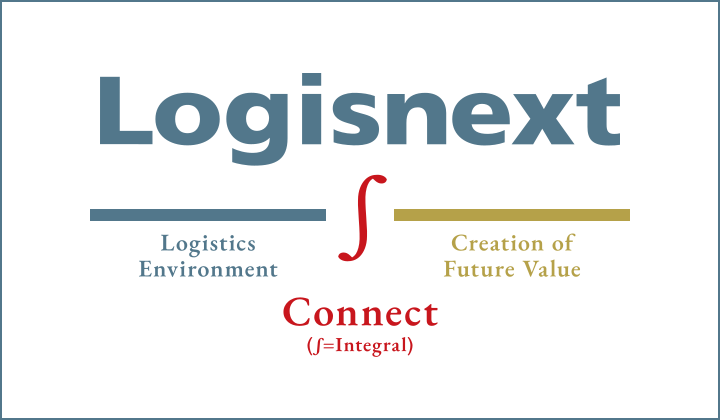
Mr. Mano: Logisnext is a coined term that represents our desire to contribute to the future by providing optimal solutions to challenges from the perspectives of logistics equipment and systems. By placing the symbol “s = ∫ (integral)” between “Logistics” and “Next,” we express our commitment to integrating the creation of future value with society’s logistics environment.
Mr. Mano: I do not believe the direction in which we are heading will change significantly. We continue to focus on three pillars: “Safety and Security,” “Automation and Autonomy,” and “Decarbonization.” We will keep our vision unchanged; increasing the sales ratio of electric vehicles to 90% and becoming a company with revenue exceeding 1 trillion yen by 2035. Furthermore, guided by our mission “We positively impact the lives of people around the world by demonstrating a pioneering spirit and using emerging technologies to deliver safe, automated and decarbonized logistics solutions,” we aim to create a supportive work environment where employees can grow every day without fear of failure. We would appreciate your continued support.
Ms. Yagi: It really struck me once again that everyday conveniences are made possible by people and technology such as purchased items being delivered to my home. I look forward to seeing Logisnext’s endeavor not just in the logistics industry, but to address challenges across society as a whole.
