


Life is a one-time journey.
Turn farewells and setbacks into strength, and live true to yourself.
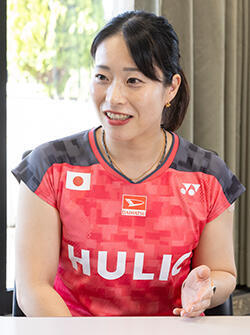 Shino Kawai
A fresh start beyond the days when hope was lost
Khor: Today, I am delighted to welcome Shino Kawai, who graduated from Hosei University's Faculty of Lifelong Learning and Career Studies in 2014. She is a former badminton player who went on to compete in para-fencing and is now a para-badminton player, with her sights set on winning a medal at the LA28 Paralympic Games. You have certainly taken a unique path in your sporting career. Could you tell us about the journey that has brought you to where you are today?
Kawai: I had been playing badminton since elementary school, and I entered Hosei University's Faculty of Lifelong Learning and Career Studies on a sports scholarship. I had planned to devote all four years at university to playing badminton, but shortly after entering university, I injured my hip and had to undergo surgery. As a result, I was barely able to compete during my first and second years at university and spent most of that time almost entirely on rehabilitation.
Khor: It must have been frustrating not being able to play the sport you loved as much as you wanted--especially during what should have been a time when you could fully devote yourself to it.
Kawai: Yes, definitely. Players with national championship titles were joining the team one after another, so I constantly felt a sense of impatience and inner conflict. However, I was able to return to competition in my third year at university, and in both my third and fourth years, I was on the team that won the team event at the All Japan Intercollegiate Badminton Championships. The joy and excitement I felt at those victories are something I will never forget.
Khor: After graduating, you joined a corporate team and went on to become an S/J League player, didn't you?
Kawai: I joined the corporate badminton team at Hokkoku Bank. However, in my second year as a working professional, I injured my hip again. I spent over a year in the hospital and underwent four surgeries, which ultimately left me with a permanent disability and forced me to use a wheelchair. I lost the athletic life I had always taken for granted, and I could no longer keep my job either. I lost all hope and spent day in complete darkness, unable to see a way forward.
Khor: What was it that helped you begin to move forward again?
Kawai: A major turning point came when I saw a younger teammate from my badminton club at Hosei University win an international tournament. In that moment, the excitement I had felt when we won the Intercollegiate Championships came rushing back. I wanted to experience that feeling again, and I realized that sport was the only way for me to do that. Another factor was simply the passage of time. Gradually, I was able to come to terms with things--to accept that I use a wheelchair and that I have a disability. Once I reached that point, I stopped thinking about how to get back what I had lost and began thinking instead about how I could enjoy life with the body I have now.
Khor: You mentioned that, over time, you came to terms with your situation. I imagine it must have taken a great deal of courage to get to that point.
Kawai: Of course, I'll keep trying until the very end. But the fact is, there are things we can change and realities we simply cannot. I can never go back to the body I had before my disability. So rather than continuing to chase something I can't get back, I came to feel that I could move forward more positively by accepting that reality and thinking instead about how I want to live with the body I have now.
A new sporting journey supported by the Hosei University network

Khor: What's interesting is that when you decided to make a fresh start, you chose fencing rather than badminton. That was a bit unexpected.
Kawai: At the time, I just couldn't bring myself to try para-badminton. Taking it up felt like admitting to myself that I now had a disability. Looking back, I don't think I had fully come to terms with that part of myself yet.
Khor: Hosei University's fencing club has produced many leading figures in Japanese fencing, including Kazuyasu Minobe. I understand that the connections you had through Hosei University also played an important role in helping you get started in fencing.
Kawai: I was truly grateful for that support. It all started when I reached out to people I knew from my university days and told them I wanted to try wheelchair fencing. When I went to the fencing facility at the Ajinomoto National Training Center, I was struck by how many athletes and coaches there were Hosei alumni. Once they found out that I had also graduated from Hosei, everyone welcomed me warmly as one of their own.
Khor: I understand that you were selected for the Japanese national team just one year after making the switch to fencing.
Kawai: The physical abilities I had developed through badminton definitely helped, but fencing was a completely different sport, so it took me quite a while to adjust.
Khor: I understand that the two sports are completely different, but from an athlete's perspective, what felt like the biggest difference between them?
Kawai: The biggest difference is the amount of time you have to react. In badminton, you can think as you play through a rally, whereas in fencing, a split-second judgment can determine the outcome. You have to anticipate your opponent's movements, and once you decide, "This is it," you have to go for it without hesitation. I was drawn to that sense of tension and the tactical back-and-forth, and I became completely absorbed in the sport.
The joy of sport opened the door to the world again.

Khor: You eventually stepped away from fencing and returned to badminton. What led to that change of heart?
Kawai: I made it as high as No. 11 in the world rankings in fencing, but I just fell short of competing at the international event in Tokyo in 2021. Of course, I could have decided to keep going and aim for the next opportunity. But when I asked myself whether I was really prepared to give everything to the next four years, the truth was that I wasn't ready to make that kind of commitment. Around the same time, the condition affecting my left leg had progressed to the point where amputation was the only option. That made me stop and take another look at what I truly wanted to pursue.
Khor: What prompted you to take up badminton again?
Kawai: It started when I happened to run into a former member of the Japanese national badminton team at the National Training Center in Akabane. They said to me, "Why don't you give it another try?" I hadn't picked up a racket in nearly nine years, so I was a little apprehensive. But when I joined a corporate team practice, the feel for the game came back within about 30 minutes. At the time, I hadn't yet had my leg amputated, and when I hit a shuttle from my wheelchair, I remember thinking, "Maybe I can still do this." That was really the point when I started thinking about giving badminton another try.
Khor: Deciding to have your leg amputated must have been an enormous decision. I was also struck by the post you shared on social media the day before the surgery: "Thank you for everything, my leg." I imagine there must have been a great deal of anxiety and inner conflict behind those words. And yet, the fact that you were able to say "thank you" in the midst of all struck me as a sign of tremendous inner strength.
Kawai: Actually, I didn't struggle with the decision that much. By then, eight or nine years had passed since I acquired my disability, and through para-sports I had met all kinds of athletes, including people who had lost a leg and people who were paralyzed from the neck down. So, for me, it was more like, "It's just that I'm going to lose a leg." That was really how I saw it.
Khor: After the surgery, you began using a prosthetic leg and returned to para-badminton. What challenges did you encounter when you returned, and what new insights did you gain?
Kawai: Para-badminton gives you a lot to think about precisely because of the different disabilities involved. You have to understand not only your own disability, but also how your opponent's disability affects the way they play, and that can significantly change your shot selection and tactics. You need to adjust your approach depending on who you're playing, which makes the tactical side of the game really interesting. It's still badminton, of course, but for me, it feels almost like taking up an entirely new sport. More than anything, it's really fun.
Khor: In February 2026, you won the Para Badminton World Championships in Bahrain. Of course, I'm sure that was the result of an enormous amount of hard work, but it also struck me just how extraordinary your athletic ability is.
Kawai: Generally speaking, it can take one to two years after an amputation to learn to walk and run with a prosthetic leg, but I was able to run again after only about two months (laughs). I'm sure my previous athletic experience helped, but more than anything, it was just fun as I hadn't walked for nearly eight years, so the joy of being able to move my body again was tremendous. In a way, it may have been a little like a baby standing up and taking their first steps. That sense of joy became what drove me every day, and I think it also helped me improve so quickly.
Khor: As I listen to your story, I notice that the word "fun" keeps coming up.
Kawai: "Having fun" is what matters most to me. When I was competing as an able-bodied athlete, I felt a lot of pressure to produce results, and at times, it felt as though I was doing it because I had to. But things are different now. I set my own goals, think things through for myself, and take on challenges because I genuinely want to. The process itself is fun. I can also feel myself growing, and I think that has become one of my strengths.
Choosing for yourself shapes a life that is truly your own.
 Kawai's strong performance at the 2025 Japan International Tournament
Khor: Are you now training with your sights set on 2028?
Kawai: Yes. I'm focusing on training, of course, but I'm also traveling overseas quite a bit for competitions. The qualification race for the Los Angeles Games hasn't really started yet, so for now, I'm working on gaining experience, improving my world ranking, and raising my overall level.
Khor: What do you find most challenging about traveling abroad for competitions?
Kawai: I often traveled abroad on my own when I was competing in fencing, and the language barrier is still a challenge. On top of that, it can be difficult to adapt to differences in food, climate, and the overall atmosphere. But I've been living this way for about eight years now, so I've become fairly used to it. In fact, being exposed to different cultures around the world has been a tremendous learning experience, and I really enjoy it. This may actually be the richest and most intense period of my life.
Khor: Everyone's circumstances are different, but there are times in life when people face setbacks or have to let go of a dream. To close, could you share a message with those who may be going through something like that?
Kawai: One day, I suddenly became disabled and found myself unable to do many of the things I had always taken for granted. That experience made me feel very strongly that we live only once. We never know what might happen, or when. That is why I hope everyone will live in a way that is true to themselves. For me, the key is making your own choices: "This is what I want, so this is the path I'm choosing." "This is my decision, so I will stand by it." I think having that sense of agency--making choices based on your own will--is what allows you to live a life that is truly your own.
Khor: Listening to your story made me reflect once again on what it really means to keep moving forward. Thank you very much for sharing your story with us today.

- Para Athlete, Model Shino Kawai
Shino Kawai was born in Toyama Prefecture in 1992. After graduating from Hosei University’s Faculty of Lifelong Learning and Career Studies in 2014, she joined Hokkoku Bank’s badminton team and competed in the S/J League. In 2018, she switched to wheelchair fencing and also began working as an athlete model. Since April 2020, she has been affiliated with Toyama Kankyo Seibi Co., Ltd. She returned to badminton around September 2024 and has since been active as a para-badminton player, including winning an international para-badminton tournament in 2025. She is now aiming to win a medal at the LA28 Paralympic Games.
- 21st President of Hosei University Diana Khor
Diana Khor was born in Hong Kong in 1960. She graduated with a B.Soc.Sc. from the Department of Sociology, the University of Hong Kong in 1983. She completed the Master’s Program (M.Phil.) in Sociology at the University of Hong Kong and the Master’s Program (M.A.) in Sociology at Stanford University. She earned a Ph.D. in Sociology from Stanford University in 1994. After joining Hosei University as a full-time lecturer in the Faculty of Liberal Arts I in 1999 and later serving as Professor in the Faculty of Law, she became Professor in the Faculty of Global and Interdisciplinary Studies in 2008. From April 2021 until March 2025, she served as Vice President and Executive Trustee of Hosei University, and on March 31, 2025, she assumed the presidency of the university. Her fields of specialization are sociology, gender, and sexuality studies.
RECOMMENDED
Published on 08/12/2025
 Alumni and Students
Draw on what I learned at Hosei University to share the appeal of shogi.
Published on 05/25/2026
 Voice
VoiceStrengthening Collaboration,
Shaping The Future of Home Economics and the University
Published on 03/02/2026
Published on 02/02/2026
 Opinion
Once you decide, see it through. It is through that process that people refine themselves.
<Alumni and Students>
New Articles
Published on 07/21/2026
 Para Athlete, Model
Shino Kawai
21st President of Hosei University
Diana Khor
Life is a one-time journey.
Turn farewells and setbacks into strength, and live true to yourself.
Published on 03/02/2026
 Screenwriter
Mash Morino
21st President of Hosei University
Diana Khor
Published on 11/25/2025
 Fashion model