


Searching for my own words and expressions,
as I wander and drift
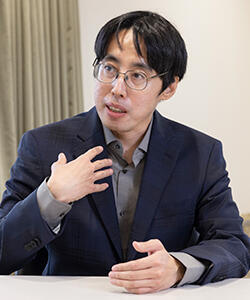 Yuki Tanaka
The quiet landscapes of the Seto Inland Sea shape my artistic style.
Khor: Today, I'm delighted to welcome poet Yuki Tanaka, whose debut poetry collection, Chronicle of Drifting, was nominated for the Poetry Award by the National Book Critics Circle in March 2026. Professor Tanaka teaches in the Department of English of the Faculty of Letters at Hosei University, but opportunities to sit down and speak with him at length like this are rare, so I've been very much looking forward to today. To begin, I'd like to ask about your recent nomination. Was it something you had expected, at least to some extent?
Tanaka: Oh, no, not at all! It never even crossed my mind. Poetry tends to receive far less attention than fiction, so I wasn't even expecting reviews. Nor was I personally notified before the announcement appeared on their official social media account. The announcement came at around 11 p.m. Japan time, and I could hardly fall asleep that night. (laughs)
Khor: I'd also like to ask about your path to becoming a poet. I understand that you grew up in Kaminoseki, Yamaguchi Prefecture. Do you feel that your childhood experiences and the landscapes you grew up with have influenced your poetry and writing today?
Tanaka: The sea appears frequently in my poetry, which I think it's largely because I grew up by the sea. The Seto Inland Sea isn't a sea of rough waves--it stretches out calmly and quietly. Some American poetry, for example, tends to unfold in a bold, forceful manner. However, my own work is much more understated and contemplative. I feel that this sensibility is closely connected to the landscapes and atmosphere that surrounded me in my childhood.
Khor: I understand that you moved to the United States to attend university. What inspired you to take that step?
Tanaka: My mother loved English and had always hoped that I would have the chance to study abroad. One day, she suddenly brought home a study-abroad brochure and said, "Why don't you take a look at this?" Since I had always loved English myself, I decided to give it a try. I first enrolled at a community college in Hawaii. The program was designed for students who planned to transfer to a four-year university, so I later transferred to the College of William & Mary in Virginia, where I majored in English literature.
The friction between English and Japanese fuels my poetry.

Khor: Had you always wanted to become a poet?
Tanaka: No, not at all. I originally wanted to write fiction. I loved reading popular mystery novels by writers such as Rampo Edogawa and Jiro Akagawa. But it gradually became clear that I wasn't probably cut out to be a novelist. (laughs) No matter how carefully I created my characters, they refused to come alive, and the stories never unfolded as I wished. That's when I realized fiction wasn't the right career for me. That experience, however, has influenced my poetry. Many of my poems have a narrative element, and my interest in narrative structure storytelling may go back to the time when I was particularly drawn to fiction.
Khor: When did you first start writing poetry?
Tanaka: I didn't start writing poetry seriously until I was in the doctoral program at Washington University in St. Louis. Having the good fortune to study with an excellent professor there played a major part.
Khor: What did you learn from that professor?
Tanaka: The most important thing I learned was that what I had been writing up to that point may have been "poetry-like," but it wasn't really contemporary poetry. For example, even if someone were to paint in the Impressionist style of Monet today, that alone wouldn't make it new art. Impressionism was revolutionary in its own time, but today it's an established tradition. At that time, I was trying to write what I thought poetry was supposed to be. But my professor taught me that, because I live in the present, I need to write the poetry of today, in the language of today. That lesson was very important to me.
Khor: What made you decide to write poetry in English?
Tanaka: Quite simply, I love the English language itself. English has a very distinct rhythm, with clear patterns of stress, and it asks you to move your mouth in a much more physical way when you speak. There're unique rhythm and musicality. At times it feels as though you're making music; at other times, it's almost like biting into a piece of fruit. I love that nature of English.
Khor: Many people would probably assume that it's easier to express yourself in your native language.
Tanaka: For me, Japanese is deeply bound up with relationships such as family and friends--as well as with the social roles. Even something as simple as the first-person pronoun, for example, boku or watashi, carries its own identity and nuance. Because Japanese is my native language, I'm constantly aware of those associations. By contrast, the English pronoun I feels remarkably neutral. In a sense, it allows me to become anyone. That sense of freedom is one of the reasons I'm drawn to writing poetry in English.
Khor: When you write poetry--even when you're transforming your own experiences into poems--are you thinking in English?
Tanaka: For the most part, I think entirely in English when I write. I don't move back and forth between English and Japanese very much. That was especially true when I was living in the United States. However, since returning to Japan and beginning to teach at Hosei University, Japanese has gradually begun to find its way into my poems. When I try to translate my experiences in Japan into English, a kind of friction emerges between the two languages. But it's precisely that gap--that slight sense of dissonance--that has become one of the driving forces behind my poetry.
Good poetry has the power to change the way we see the world.

Khor: I understand that you also translate. What does translation mean to you?
Tanaka: Translation is a tremendous source of creative energy for me. If I only write my own work, my creative sensibility can easily become set in its ways. But when I translate another poet, I encounter words and expressions that would not occur to me in my own writing. I enjoy bringing that new sensibility into my own poetry. At the same time, translation also comes with constraints. If the original says "an apple," I can't simply change it to "a panda" or "a chair." In my own poetry, however, I am free to change the words as much as I like. That's why returning to my own work after translating feels so liberating. It's like a swimming pool and then going out into the open sea.
Khor: I realize it's quite difficult to make a direct comparison since we have different forms of writing, but when I write, I'm always conscious of my readers to some extent. How about you when writing your poetry?
Tanaka: I've always written without thinking of readers at all. Perhaps it'd have been different if poetry were a more a part of everyday life and more widely read as a matter of course. Of course, I do have something like an "ideal reader" in mind--someone whose judgment tells me whether a poem is good or not. But I don't write with any particular person, or with readers in general, in mind.
Khor: In your view, what makes a "good poem"?
Tanaka: I have my own criteria, but the most important is that a poem should contain an element of surprise. I want something beyond familiar or conventional expressions--a moment when something we are used to seeing suddenly looks different. For example, there's a line from a poem from China's Tang dynasty that I particularly love. It says, "The moonlight is so beautiful that I want to scoop it up in my hands and bring it to you. But I cannot." Anyone can say that the moon is beautiful. But this poet described the moonlight as something that could be "scooped up" like water. There is a leap in that expression. It makes something familiar appear unfamiliar. This is what is often called "defamiliarization," and I believe it is an important power of poetry.
Khor: My own background is in sociology, so when I analyze or interpret something, I'm conscious that there's some degree of "correctness." Poetry seems quite different, though, because Readers may take different things from the same poem. When you write, is there a particular way you hope readers will read your work?
Tanaka: Once I finish writing a poem, I feel that it is no longer in my hands. For me, the act of writing is everything. After that, readers are essentially free to interpret it. As a poet, what I feel most of all is simply, "Thank you for reading."
Surrealism is the imagination that softens reality.
 Cover illustration: Seiji Togo, A Surrealist Stroll (1929, collection of the SOMPO Museum of Art)
Khor: Some reviewers have described your poetry as "surrealist." How do you feel about that characterization?
Tanaka: I think it is something like softening the reality we find ourselves in. Imagine a loaf of bread that has become completely hard. If you soak it in water, it softens almost instantly. Reality is similar: through imagination, we can loosen our fixed ways of seeing the world. By softening reality in this way, other perspectives and new forms can begin to emerge. That is close to how surrealism feels to me.
Khor: As the title of your first collection, Chronicle of Drifting, suggests, your poetry has a an imaginative freedom and expansiveness born of drifting, which I find deeply compelling. At the same time, contemporary society seems to place a great deal of value on stability and on maintaining an objective view of oneself. As someone who works closely with students, what are your thoughts on this?
Tanaka: Indeed, there may not be many students who feel they're drifting. In fact, I sometimes find myself wishing we lived in a society where people could drift a little more. Perhaps there simply isn't much room for leisure. What do you think, Professor Khor?
Khor: Many of the students in my department have spent a significant amount of time overseas or come from multicultural backgrounds. Quite a few of them find the prevailing expectation in Japanese society--that there's a single "right" path, where you're supposed to choose a certain career at a certain kind of company--rather stifling.
Tanaka: I can relate to that. When I was living in the United States, I often found myself thinking how nice it was to have that kind of freedom. Taking a gap year, for example, is relatively widely accepted, and pausing for a while or taking a detour is viewed less negatively than it is in Japan. I had a sense that there was more room to "drift" a little.
Khor: At a time when it is not easy to drift, I think many students are uncertain about their future paths and how they want to live. Finally, what message would you like to share with young people facing those uncertainties?
Tanaka: That's probably the hardest question. (laughs) In fact, when I was a student, the kinds of words adults offered--such as those in commencement speeches--did not resonate with me very much. These days, I sometimes feel that words offered by others no longer have as much power as they once did. So, if there is one thing I can say, it is this: "I hope you will find your own words." Poetry, too, is ultimately about searching for your own words. Rather than simply receiving someone else's words, I believe that finding your own form of expression can become a source of strength.
Khor: That sounds very much like you, Professor Tanaka--a wonderful message of encouragement. Thank you very much for sharing such valuable thoughts with us today.

- Poet and Translator Yuki Tanaka
Yuki Tanaka was born in Yamaguchi Prefecture in 1982. He is a full-time lecturer in the Department of English, Faculty of Letters, at Hosei University. He specializes in modern and contemporary English-language poetry and writes poetry in English. He earned an MFA from the Michener Center for Writers at the University of Texas at Austin and a Ph.D. in English Literature from Washington University in St. Louis.
His recent publications include his first poetry collection, Chronicle of Drifting (Copper Canyon Press, 2025), and A Kiss for the Absolute: Selected Poems of Shuzo Takiguchi (co-translated with Mary Jo Bang; Princeton University Press, 2024). His English translation of Shizuka Omori’s tanka is forthcoming from Copper Canyon Press in 2027.
- 21st President of Hosei University Diana Khor
Diana Khor was born in Hong Kong in 1960. She graduated with a B.Soc.Sc. from the Department of Sociology, the University of Hong Kong in 1983. She completed the Master’s Program (M.Phil.) in Sociology at the University of Hong Kong and the Master’s Program (M.A.) in Sociology at Stanford University. She earned a Ph.D. in Sociology from Stanford University in 1994. After joining Hosei University as a full-time lecturer in the Faculty of Liberal Arts I in 1999 and later serving as Professor in the Faculty of Law, she became Professor in the Faculty of Global and Interdisciplinary Studies in 2008. From April 2021 until March 2025, she served as Vice President and Executive Trustee of Hosei University, and on March 31, 2025, she assumed the presidency of the university. Her fields of specialization are sociology, gender, and sexuality studies.
RECOMMENDED
Published on 08/12/2025
 Alumni and Students
Draw on what I learned at Hosei University to share the appeal of shogi.
Published on 05/25/2026
 Voice
VoiceStrengthening Collaboration,
Shaping The Future of Home Economics and the University
Published on 03/02/2026
 Alumni and Students
Published on 02/02/2026
 Opinion
Once you decide, see it through. It is through that process that people refine themselves.
 Poet and Translator