


Strengthening Collaboration,
Shaping The Future of Home Economics and the University
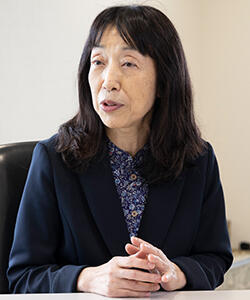 Keiko Takano
Home economics transforms society through everyday life.
Khor: In March 2026, Hosei University and Tokyo Kasei Gakuin University signed a basic agreement to strengthen collaboration between the two institutions. As part of this process, Tokyo Kasei Gakuin Junior & Senior High School will be brought into the Hosei University network from April 2027, and ties between the two universities are also expected to deepen further. Today, we are joined by President Keiko Takano of Tokyo Kasei Gakuin University. We hope to discuss the background to this close partnership, its future prospects, and the future role and direction of universities.
Takano: Thank you. As its name suggests, Tokyo Kasei Gakuin University has long provided opportunities for practical learning centered on home economics. I have served as president since April 2021, although my field of expertise is theoretical chemistry, which is quite different academically. Even so, I am often continually struck by the breadth and depth of home economics, and my interest in the field has continued to grow.
Khor: Many people still think of home economics as a field intended for training women to become "good wives and wise mothers." In reality, however, it is an applied science closely connected to everyday life--and a highly contemporary and practical field of study.
Takano: Exactly. Last year, the Faculty of Lifestyle Co-Creation was established at our Machida Campus. As one of our professors explained in class, "The purpose of home economics is to consider and propose, from the perspectives of people in their everyday lives, ways for everyone to maintain a high quality of life and live with a sense of purpose throughout their lives." To dispel the fixed images that have long surrounded home economics, I believe we need to communicate more clearly that it is a discipline that seeks to "change society from the perspective of everyday life."
Khor: I think the launch of the Faculty of Lifestyle Co-Creation is one example of that. Since becoming president, you have pursued a range of initiatives, unconstrained by conventional thinking, haven't you?
Takano: Rather than focusing primarily on employment, we developed an internship program that students can join from an early stage, including in their first year, as an opportunity to learn more about society. I launched the program in the hope that students would also explore industries and companies outside their own fields of study. Another initiative was academic crowdfunding, which we introduced to further stimulate faculty research. Three faculty members took part, and all three successfully reached their fundraising targets.
Khor: What were the research projects about?
Takano: Let me highlight two of the projects.
One explored what children's eating with their hands as they transition to solid foods can reveal about the richness of the human experience of eating and child development. The other examined how incorporating opportunities for children to listen closely in early childhood care and education settings can help foster multisensory cognition. Academic crowdfunding is particularly attractive because it gives researchers considerable flexibility in how the funds are used, while also providing a valuable opportunity to help the wider public understand the university's research.
Becoming fully coeducational: Toward a more open university while preserving the strengths of a women's university

Khor: Tokyo Kasei Gakuin has a long history as a women's university, but in recent years it has been moving toward coeducation. I'd like to take this opportunity to discuss our collaboration in more depth. Could you start by telling us what led to the collaboration?
Takano: We are a small university specializing in home economics. The close, attentive education that our small size makes possible has long been highly valued. At the same time, being small also presents financial challenges. We also faced the challenge that our limited range of fields made it less likely for prospective students to see us as an option.. Against this background, we thought long and hard about how we could further enhance our educational environment while preserving the strengths unique to a small university. That process ultimately led us to this decision.
Khor: This isn't the first time Tokyo Kasei Gakuin University and Hosei University have worked together. Both universities have long been members of the Chiyoda Campus Consortium, which aims to strengthen collaboration among universities within walking distance of each other in Chiyoda Ward. Through the consortium, we've undertaken initiatives such as credit transfer. I feel that it is precisely because we have worked together in this way over the years that this closer partnership enables us to further develop our existing initiatives.
Takano: Against the backdrop of the rapidly declining birthrate, I expect more universities will move towards similar forms of collaboration as they plan for the future.
Khor: I don't think this is something individual universities can address on their own. These changes are tied to Japan's future and the international competitiveness of its education. That's precisely why universities need to work together, drawing on their respective strengths to develop new approaches to education.
Takano: I strongly share your view that as society changes, universities themselves need to be willing change as well. Tokyo Kasei Gakuin has a 100-year history as a women's university, but the Machida Campus became co-educational in 2025, followed by the Chiyoda Sanbancho Campus in 2026, making all our faculties co-educational. One important factor behind this transition has been the growing awareness of gender equality across society. At the same time, we see coeducation not simply as a response to a broader social trend, but more positively--as an educational opportunity to create new forms of collaboration that go beyond conventional gender categories.
Khor: Did coeducation change the atmosphere of the Machida Campus?
Takano: The campus as a whole feels livelier. It has retained the calm atmosphere it had as a women's university, while also gaining a new sense of energy. We've also seen new developments, such as an increase in sports clubs and male students starting a cooking club. One member of the cafeteria staff even remarked in surprise, "Male students really do eat a lot, don't they?" (laughs) Through these changes, I have come to feel that the university is a more diverse place, with stronger connections to society.
The potential of cross-disciplinary exchange

Khor: With this closer partnership, what possibilities do you see for collaboration between high school and university ?
Takano: In home economics, we place great importance on looking at issues from the perspective of people in their everyday lives. We also see home economics at the junior high and high school levels as a subject grounded in the academic field of home economics and aimed at developing the skills students need for life. I therefore hope that our faculty can contribute to strengthening home economics education and inquiry-based learning at Hosei University's affiliated schools.
Khor: Inquiry-based learning also often focuses on issues closely connected to everyday life, such as the SDGs, so it is very reassuring to know that we will be able to draw on your university's expertise.
Takano: Yes. I believe that learning from the perspective of people in their everyday lives is extremely important for both secondary school students and university students. It encourages them to reflect on their daily lives and consider how to live better. I hope we can draw on our university's expertise to contribute to this kind of learning--learning that supports well-being.
Khor: There also seems to be tremendous potential for exchange not only among students, but among researchers as well. The more active these exchanges become, the more likely they are able to spark new ideas and collaborations
Takano: Each university has its own areas of strength, and I hope that by taking part in each other's activities, we can generate new ideas and insights. We have some areas in common, it is precisely the differences between us that can be stimulating. By bringing together our respective expertise--for example, Hosei University's strengths in economics and social welfare studies, and ours in nutrition, food, as well as childhood education--I believe we can create significant synergies.
Khor: I totally agree. The differences between our curricula are precisely what make it so valuable for our students to encounter subjects they cannot study at their own university. But the value lies not simply in filing gaps; it lies in the way students in the two universities can stimulate and inspire each other. Even when students or researchers are exploring the same topic, each university has its own environment and culture, and exposure to those differences can itself be immensely valuable. We now live in an age when no single discipline can solve the challenges we face. That is why collaboration across disciplinary boundaries will become increasingly important.
Learning Freely Across Disciplines and National Borders
Khor: Speaking with you today, Professor Takano, has made me realize just how much this partnership can expand the possibilities of home economics. Home economics is an essential field for understanding how people live, but it has often been viewed primarily as a field for women. Going forward, it needs to evolve into a field that is not defined by gender, while incorporating a broad range of disciplines such as nutrition, psychology, and public health. I hope Hosei University can also play a role in supporting that development.
Takano: Daily life is the foundation of how we all live. In that sense, I believe home economics--or human life sciences--is connected to every field of study. For our students, collaboration with a comprehensive university like Hosei University will create more opportunities to encounter a broader range of knowledge and perspectives. At the same time, I hope that Hosei University students, by engaging with what we teach in home economics, will find opportunities to reflect on their own lives and the way they want to live.
Khor: By the way, Professor Takano, what kind of graduates do you hope your university will produce?
Takano: How each person wants to live is deeply personal, and there is no single right answer. That's why I hope students will value their own way of life while also respecting the values and ways of life of others. To do so, I want them both to develop a mindset that enables them to respect and care for themselves and others and acquire the expertise needed to address social issues.
Khor: I completely agree. People who combine expertise with independent thinking and the initiative to act--and who use those qualities to contribute to others and to society--are perhaps the kind of people universities should aspire to nurture, even as times change. In addition, a global mindset will be essential going forward. We want to nurture students who can see themselves within a broader global context and ask how they can contribute.
Takano: Absolutely. Home economics, for example, includes research that overlaps with engineering, such as studies on biodegradable fibers designed to reduce environmental impact. Academic disciplines do not have clearly defined boundaries; they are all connected in one way or another. Home economics, too, is deeply connected to society and the wider world, and I believe it can help students develop an international outlook and new values.
Khor: I imagine many prospective students are paying close attention to how Tokyo Kasei Gakuin University will develop in the years ahead. To close, what would you like to say to the younger generation?
Takano: As you prepare for university entrance examinations, I hope you will stay attentive to your own feelings and instinct and think carefully about what you truly want to study. You may have doubts along the way, but that is not necessarily a bad thing. By attending open campus events and exploring different possibilities, I hope you will gradually discover where your interests lie. In the end, I hope you will choose a path that feels right to you.
Khor: Absolutely. Let's continue working together to create new forms of learning, so that every student can envision a future that is true to who they are.

- President, Tokyo Kasei Gakuin University Keiko Takano
Keiko Takano was born in Shizuoka Prefecture in 1956. She graduated from the Department of Chemistry, Faculty of Science, Ochanomizu University, in 1979, and subsequently completed the master’s program in chemistry at the university’s Graduate School of Science, earning a Master of Science. She received her Doctor of Science degree from Osaka City University in 1988. She joined the Faculty of Science at Ochanomizu University as an assistant professor in 1981 and later served as an associate professor before becoming a professor in the Natural Sciences Division of the Faculty of Core Research. During this period, she was a Ministry of Education overseas research fellow at Iowa State University in the United States in 1992, was concurrently an academic research officer at the Ministry of Education from 1995, and a visiting professor at Université Louis Pasteur in France in 2004. In 2007, she became Assistant to the President of Ochanomizu University. She subsequently held a number of concurrent positions, including member of the Education and Research Council, Director of the Center for Leadership Education and Research, and Vice President from 2011 to 2015. She is Professor Emerita of Ochanomizu University and has served as President of Tokyo Kasei Gakuin University since April 2021. Her field of specialization is theoretical chemistry. Her principal academic affiliations include the American Chemical Society, the Chemical Society of Japan, the Japan Society for Molecular Science, the Society of Theoretical and Computational Chemistry, and the Society of Computer Chemistry, Japan.
- 21st President of Hosei University Diana Khor
Diana Khor was born in Hong Kong in 1960. She graduated with a B.Soc.Sc. from the Department of Sociology, The University of Hong Kong in 1983. She completed the Master’s Program (M.Phil.) in Sociology at The University of Hong Kong and the Master’s Program (M.A.) in Sociology at Stanford University. She earned a Ph.D. in Sociology from Stanford University in 1994. After serving as Full-Time Lecturer in the Faculty of Liberal Arts I, Hosei University in 1999, and then as Professor in the Faculty of Law, she was appointed as Professor in the Faculty of Global and Interdisciplinary Studies since 2008. From 2021 until March 2025, she served as Vice President and Executive Trustee of Hosei University. She was appointed as President of Hosei University on March 31, 2025. She specializes in sociology, gender, and sexuality.
RECOMMENDED
Published on 08/12/2025
 Alumni and Students
Draw on what I learned at Hosei University to share the appeal of shogi.
Published on 05/25/2026
Strengthening Collaboration,
Shaping The Future of Home Economics and the University
Published on 03/02/2026
 Alumni and Students
Published on 02/02/2026
 Opinion
Once you decide, see it through. It is through that process that people refine themselves.
<Voice>
New Articles
Published on 05/25/2026
 President, Tokyo Kasei Gakuin University
Keiko Takano
21st President of Hosei University
Diana Khor
Strengthening Collaboration,
Shaping The Future of Home Economics and the University
 Novelist
 Cross-Border Strategic Consultant & Advisor